What Went Wrong in “Nomen Omen” #1?

Written by Marco B. Bucci
Art and Colors by Jacopo Camagni
Letters by Fabio Amelia (Arancia Studio)

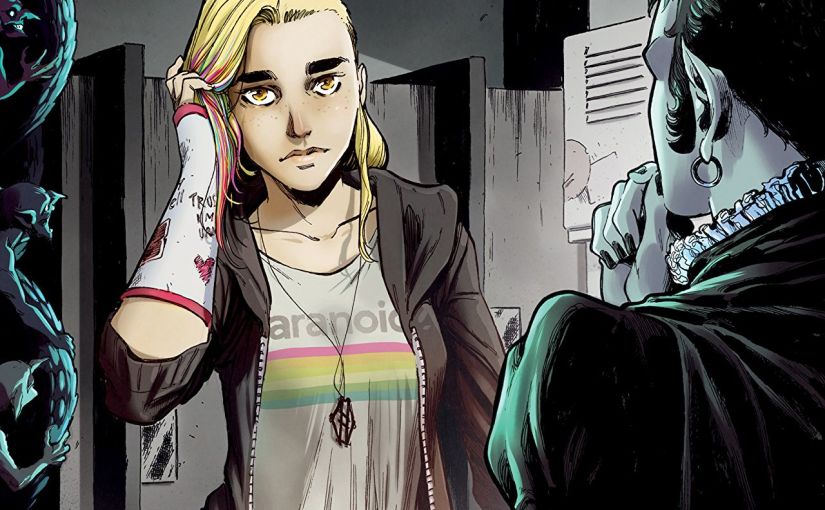
“Nomen Omen” #1 from Image Comics is a supernatural/fantasy/horror comic that is equally disturbing and confusing. Brought to life by a team of Italian creators, there were a few things lost in translation — and it’s not because of language differences. This is a comic that is too smart for its own good.

In typical Italian fashion, “Nomen Omen” #1 opens with a lusty pretext. (My grandmother immigrated to NYC from Sicily, so I am somewhat qualified to call Italians a lusty people.) Two young women hit the road after they were caught bathing in the moonlight, naked (of course). There’s some other confusing details about their families and plans for the future before they discover the car crash that will kickstart the story into motion.

I’m not here to give you a panel-by-panel recap of “Nomen Omen” #1. But I feel that these first four pages — arguably some of the most important pages in the first issue of a series — represent a larger problem of this story: all of the disorientation that Bucci creates makes it hard to invest in the characters and their story.

The story is punctuated with vague incantations talking about some ominous future, which can be exhilarating and leaving you wanting to know more. There’s some very sexual panels, and very violent ones. There is an entire page of poetry, framed inside a glowing moon, which spoke to the nerdy English major within me. If you’re patient enough to parse the verses, you’ll find some foreshadowing that can help you see through the fog in the coming pages.

Fabio Amelia’s letters bring the story to life. He uses variations in font size, word bubble outlines, color of sound effects to give this story an edge. In a double page splash that depicts the inciting incident in the story, his sound effects rhythmically guide your eyes across the page, and give the action a tribal quality with the repeated “tum” drumming sound. When the evil character speaks at the end of the book, his words are coated in black, outlined by a wobbly bubble that gives his speech a guttural, dark quality.

The art from Jacopo Camagni in “Nomen Omen” #1 has a unique interpretation of manga style, and some of the page/panel layouts are spectacular. The latter half of the book is predominantly black and white, with the exception of a bright, beating heart and pink fur in two consecutive pages. Camangi knows how to create a dramatic, disturbing sequence of action that really move the story forward in the direction Bucci is trying to guide it.

My favorite part about his art is all the attention to detail. In one panel inside the protagonist’s home, her photo wall reveals that she won the Google Science Fair and that her parents support the All Genders Matter movement. This quickly conveys characterization, with no dialogue or captions required. For all his attention to detail in bringing the story elements to life, Camangi barely did any crosshatching, which is a classic way to convey dimension in skin and fabrics. The lack of gritty, fine lines makes some panels fall flat, but Camagni’s expertise in using color for lighting/shadow while masterfully illustrating perspective makes up for that shortage.

And then there’s the incorporation of instagram in the story. I often feel that comic books (and the entertainment industry in general) haven’t found impactful ways to integrate technology into the plots of regular stories (in a more casual way than Black Mirror does). An entire page of the comic resembles an instagram feed, and at the bottom it displays the instagram handle @_nomen.omen_. There is no sign of these panels on that instagram page, and I’m perplexed as to how that account relates to the story — aside from the posts of the rainbow birthday cake, which was featured in the comic.

The artistic features of this story are truly something to behold, and if you’re patient enough, I think Bucci’s writing will find its footing in the issues to come.

Review of SHE SAID DESTROY #1 from Vault Comics

What’s SHE SAID DESTROY issue one about?

Good versus evil is a classic comics trope. That formula gets a lot more interesting when traditionally evil forces are on the same side as the good guys. Enter the Goddess of death and queen of fairies, The Morrigan.

She is one of the two remaining Gods from her pantheon, who were forgotten and erased. Her only remaining sister, Brigid (Goddess of the Sun) has persuaded the entire solar system into devoutly following her, using the force of inspiration. The Morrigan and her people, who reside in the colony of Fey, are the last obstacle in her quest for domination.

The Sun Goddess, Brigid, about her flagship, The Inspiration.
The Sun Goddess, Brigid, aboard her flagship, The Inspiration.

The only thing stopping Brigid from conquering The Morrigan and converting her followers are Jackelyn (a galactic witch), Winona (the princess of Fey), and her best friend, Raul.

How’s the reading experience?

On the first page, author Joe Corallo implies that because “some gods wanted more,” “cultures were homogenized and erased.” No details of this backstory come through in the issue, but it affirms that Brigid is the antagonist; in her crusade to get every person to conform to her worldview, Brigid has effectively erased the many cultures of the solar system.

Page one of SHE SAID DESTROY introduces the reader to the history of this fantasy universe.

It’s clear the Brigid is motivated by the fate of the other gods: she fears being forgotten as they were. This premise is not entirely unique, and I did not feel an attachment to Brigid and The Morrigan. Their characterization, motivation, and relationship to each other rung hollow.

The apparent protagonist of the series, Winona exudes strong Jon Snow vibes — noble, skilled, and persistent, but somewhat uncomfortable in the spotlight. Much like Brigid and The Morrigan, unfortunately, Winona’s personality is one-dimensional. She is kind to everyone, a good friend, and appreciative of life, but neither Corallo, Kangas (artist), nor Nalty (colorist) indicated that she has endured trauma, or is capable of being anything but good.

Introduction of Winona, and her friend, Raul, who is jealous of her power and prominence in Fey.

This story has the pieces of a successful comics saga: space opera genre, with fantasy and sci-fi elements, conflicting belief systems about to be at war, and an inclusive cast of characters and creators. But did these pieces come together? Not in my opinion.

How’s the art in SHE SAID DESTROY?

Generally, the art in this debut issue parallels the quality of the storytelling: many flat colors, line-work that feels hasty and incomplete, and attempts to convey motion that feel static nonetheless. Often, I couldn’t clearly discern what I was viewing. Even if this visual disruption was intentional, it evoked no emotional response in me.

I will credit Kangas and Nalty with the ability to create imaginative worlds, expressive costumes, and memorable faces with even more distinct facial expressions — this, especially, is rare. All these strengths were apparent in the differences in Brigid and The Morrigan. Exuding a magical aura, the Sun Goddess was regal, enshrined in gold, ephemeral, and evidently at the peak of her power. On the other hand, Brigid, whose powers are waning, had a relaxed posture, more woodsy garb, and several fairies floating around her.

The Saga homage variant of SHE SAID DESTROY issue one.

Should you invest in this series?

After the first reading, I felt profoundly unmoved. After the second round, I felt more appreciation for the narrative structure, characters, and message — but still unmoved.

There is a distinct lack of pacing and world-building that manifests in the hurried art. I most likely will not continue reading SHE SAID DESTROY #1, but respect the intentions of its creators.

Rating 6.5 / 10