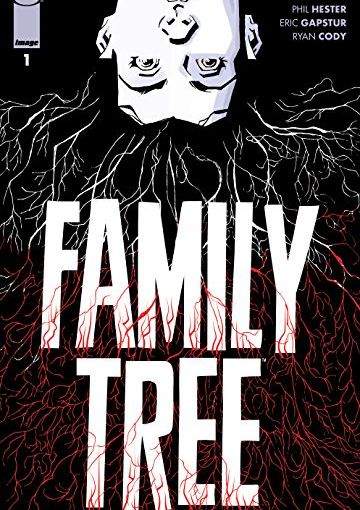
“Family Tree” And the End of the World: Spoiler-Free Review

In March 1997, the world started to end with a little girl named Meg, and the tree branch that sprouted from her back. 

Written by Jeff Lemire
Illustrated by Phil Hester
With Eric Gapstur and Ryan Cody

A Story About Family

If you’ve read Jeff Lemire’s comics, you know that family and childhood are big sources of inspiration for him. This excellent series debut from Image is no exception. obviously — I mean, it’s called Family Tree

The dynamics between single mom Loretta, her troubled teenager Josh, and her naive daughter Meg make Family Tree #1 equally entertaining and heartbreaking.

The first issue focuses on Loretta’s worldview and the daily humdrum of her life. Panels showing the inside of her humble home resemble early-2000s episodes of Malcolm and the Middle, a sitcom about a low-income family who are looked down upon by their neighbors. (For the Malcolm in the Middle fans out there, Loretta works at a grocery store, just like Louis. Conspiracy or coincidence?) 

Tone and Mood

Loretta narrates the story in a frank, introspective, tone that matches her no-bullshit personality and dry humor. As you flip through the pages, you see her triumph over the people who patronize her, which is, again, just like Louis from Malcolm in the Middle. It is immensely satisfying to see Loretta question her son’s bald principal “What would you know about a strong male presence?” when he implies that her parenting is the reason Josh got caught with weed in his backpack at school. Josh’s absent dad is just one of three big mysteries in Family Tree #1.

This is just one example of how the creators of Family Tree effortlessly foreshadow revelations about family history and the impending doom. Another example of this happens on panel when Loretta makes eye contact with a menacing man at the grocery who clearly isn’t there to buy ingredients for dinner. On the page, he overshadows three panels showing Loretta’s stern reaction to the uncomfortable situation.

Eerie and Economic Art

The dread is palpable on every page, between Loretta’s exasperated facial expressions of the increasingly severe “rash” progressing on her daughter’s arm. The character design and setting are 90s without being cloyingly nostalgic, lending some authenticity to the story. Dull greens, oranges, yellows, and purples reinforce the mood that something dark and sinister — but also strangely beautiful — is unfolding. White spaces within and between panels alleviate some of the emotional heaviness while also bringing important story elements into focus. 

When such an intriguing concept is backed by concise writing and genre-defying art, it deserves attention.

Rating 

8.7/10

Follow this family drama as it branches out into the mystery and action that Jeff Lemire and his collaborators planted in issue one.
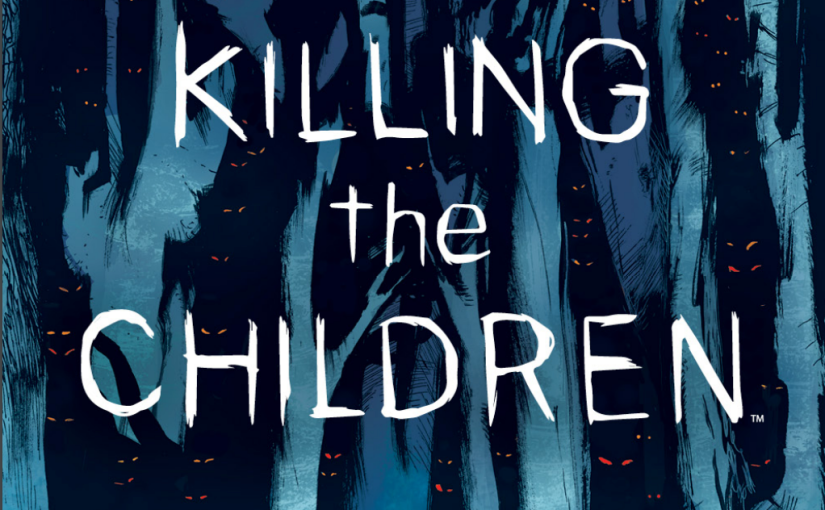
Review: Something is Killing the Children #1

Nine kids have died, and dozens are missing in Archer’s Peak, Wisconsin. With Something is Killing the Children #1, BOOM! Studios brings us the best horror comic I’ve read all year. In every page, the paranoia is palpable, and each character feels a sense of isolation and doubt.

James, the protagonist, finally made the kind of friends you’d have sleepovers with. On the night of one of those sleepovers, they all die in the woods — moments after he tells them a true (?) story about a monster that resembles the thing that killed them. When James describes the events of that night to the police, he reveals that the story he told his friends during Truth or Dare was made up.

He’s also lying to the cops, and says that he didn’t see anything that night. That he only heard the massacre. Writer James Tynion IV has given us an unreliable narrator to convey this horrific story, and I’m skeptical of everything he says — even though I empathize with him.

Part of the reason I have a complex relationship with this protagonist is because of Werther Dell’Edera’s humanizing art, and Miquel Muerto’s consistently immersive colors. The story is interspersed with extreme closeups that convey anguish, confusion, and sorrow. Distinct hatching adds weight to these facial expressions, and creates shadows that support the mood and atmosphere.

Together, these two artists have created a unique interior style that is unlike anything I’ve gazed upon in recent memory. Particularly, they use two consecutive double-page spreads to show every gory detail of what really happened that night in the woods. (I’ll save that experience for when you pick up the book, but here’s a similar spread below.)

Supporting the gestural brushstrokes and muted watercolors of blue, green, purple, and yellow are Andworld Design’s letters. In a scene where one of James’ classmates accuses him of murdering his friends because he’s gay and was experiencing unrequited love, James says “Shut up” in gray letters that are slightly smaller than the others on the page. Further down that page, he screams in frustration, “SHUT THE FUCK UP!” Without this contrast, that raw moment of would have lost its effect.

There was only one flaw I noticed in the whole pilot to this gripping series. Earlier in the book, we learn that James’ three dead friends are named Karl, Robbie, and Noah. At the end of the book, when we see the flashback of the massacre, James calls Robbie Tyler. I reread the issue three times to sort this, and still have no answers. I’m assuming it’s a mistake, but will confirm it as I continue to invest myself in this horror tale.

This isn’t just a horror story, though. It’s an analog for how school shootings have damaged our national conscience, how the news ineffectually covers the epidemic, and how police are ill-equipped to combat the problem.

Throughout the debut issue, Tynion’s dialogue resonates with a nation grappling with the reality that children are killing each other, with more and more frequency, more audacity. Here’s a quote from the comic that sums it up: “…the world makes a lot less sense than it used to. And every day that feeling gets a little worse.”

Rating: 4 out of 5.