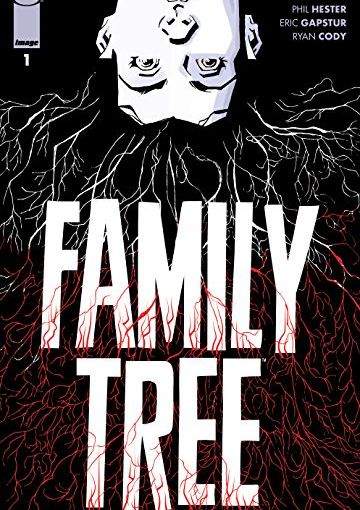
“Family Tree” And the End of the World: Spoiler-Free Review

In March 1997, the world started to end with a little girl named Meg, and the tree branch that sprouted from her back. 

Written by Jeff Lemire
Illustrated by Phil Hester
With Eric Gapstur and Ryan Cody

A Story About Family

If you’ve read Jeff Lemire’s comics, you know that family and childhood are big sources of inspiration for him. This excellent series debut from Image is no exception. obviously — I mean, it’s called Family Tree

The dynamics between single mom Loretta, her troubled teenager Josh, and her naive daughter Meg make Family Tree #1 equally entertaining and heartbreaking.

The first issue focuses on Loretta’s worldview and the daily humdrum of her life. Panels showing the inside of her humble home resemble early-2000s episodes of Malcolm and the Middle, a sitcom about a low-income family who are looked down upon by their neighbors. (For the Malcolm in the Middle fans out there, Loretta works at a grocery store, just like Louis. Conspiracy or coincidence?) 

Tone and Mood

Loretta narrates the story in a frank, introspective, tone that matches her no-bullshit personality and dry humor. As you flip through the pages, you see her triumph over the people who patronize her, which is, again, just like Louis from Malcolm in the Middle. It is immensely satisfying to see Loretta question her son’s bald principal “What would you know about a strong male presence?” when he implies that her parenting is the reason Josh got caught with weed in his backpack at school. Josh’s absent dad is just one of three big mysteries in Family Tree #1.

This is just one example of how the creators of Family Tree effortlessly foreshadow revelations about family history and the impending doom. Another example of this happens on panel when Loretta makes eye contact with a menacing man at the grocery who clearly isn’t there to buy ingredients for dinner. On the page, he overshadows three panels showing Loretta’s stern reaction to the uncomfortable situation.

Eerie and Economic Art

The dread is palpable on every page, between Loretta’s exasperated facial expressions of the increasingly severe “rash” progressing on her daughter’s arm. The character design and setting are 90s without being cloyingly nostalgic, lending some authenticity to the story. Dull greens, oranges, yellows, and purples reinforce the mood that something dark and sinister — but also strangely beautiful — is unfolding. White spaces within and between panels alleviate some of the emotional heaviness while also bringing important story elements into focus. 

When such an intriguing concept is backed by concise writing and genre-defying art, it deserves attention.

Rating 

8.7/10

Follow this family drama as it branches out into the mystery and action that Jeff Lemire and his collaborators planted in issue one.

Space Bandits #1 Review

It’s no secret that entertainment companies feel obligated now to make films about women. As a woman, I think this is a good thing. As a person who like quality entertainment, this can be a bad thing. It can result in shows made from a bland recipe of data analytics and market predictions. Netflix is known for this approach. And I fear that with Space Bandits, Mark Millar might be garnering a similar reputation.

Since 2017, Netflix owns Mark Millar’s creative properties. Anyone who’s finished a Millar comic since then has seen the Netflix brand logo at the end. The interesting thing is that Netflix came up with the concept for Space Bandits, while Millar is tasked with putting the story on shelves. I’m more interested in that business relationship — and what it says about the direction of the comics industry — rather than Space Bandits and its many clichés.

In this comic, protagonists Thena Khole and Cody Blue are notorious space bandits on the hunt for the ultimate reward: revenge on the men who betrayed them. In issue one, both women meet in prison after they were abandoned by their partners in crime and apprehended. To the audience, it will resonate with recent reporting on how women are getting screwed over personally and professionally by men. To me, it weakly accomplishes that. So far, Space Bandits seems to be a typical brains vs brawn story.

Millar suggests that he was filling a gap in the market with this comic. “In a world with a billion superhero properties and gloomy, rain-soaked dystopian sci-fi, there’s a gap in the market for sci-fi that’s upbeat and fun. I wanted to combine all this into a big, high-octane story.” His assessment of the market is spot on. His description of the story is not.

The only “big” thing for me in issue one is the 100-mile long dead lobster that is “being mined by thousands of the universe’s most dangerous prisoners” — including Thena and Cody. Whether or not this is Millar’s critique of the prison-industrial complex remains to be seen. Apparently, this crustacean floating in outer space used to be worshipped as a god before been mined for the cure to at least 42 fatal diseases. I’m curious to learn how the lobster died, whether or not that’s why the universe stopped worshipping it, and what significance this strange symbol has to Millar’s broader ideas.

The only upbeat thing in issue one is the fixation on 1980s fashion sensibilities and pop culture. There’s shoulder pads, teased hair, leg warmers, a Lionel Richie cruise ship, a Molly Ringwald district. Matteo Scalera (art) and Marcelo Maiolo (colors) create an atmosphere that exudes the big personality, bold colors, and attitude of the ’80s. Why this decade is of importance to the storytelling, I’m not quite sure yet.

I might be premature in my judgment of this series. Maybe because I just finished my second reading of Watchmen, I have higher-than-usual expectations for stories written at the height of geopolitical angst and global uncertainty. There’s no doubt that Millar’s stories resonate with people around the world. But this does not feel like his best effort, and I suspect that’s because Space Bandits wasn’t his idea.

In the grand scheme of things, this comic is just another meaningless blip in the cosmos of content that includes women, but doesn’t do them the honor of including them in a good story.