Batman: Damned Review

Brian Azzarello’s and Lee Bermejo’s disorienting run together on Batman: Damned can be interpreted in many different ways, and I think that’s partly the point. I won’t be the authority on this story. I think the closest person to come to that — other than Azzarello himself — is Rich Johnston in his recent review, which connects the Damned to Alan Moore’s Killing Joke and Azzarello’s Joker from nearly a decade ago. Instead, I’ll share my interpretation, which is one I didn’t find elsewhere in the other reviews I read.

I’ll skip over the controversy of Bat Wang, the complaints about Azzarello’s relentless punning, the bitching about how flat the blood looks, and get right to the point of my review. I think that superhero comics, at their best, are always a mythology story. Batman: Damned is a mythological story about a man confronting fear, lack of control, judgment, childhood trauma, and desire. It features infidelity, weeping, attempted rape (a more sensible version than the attempted rape in Miller’s Superman: Year One), empathy, confusion, and all the other emotions that make being human so damn exhausting.

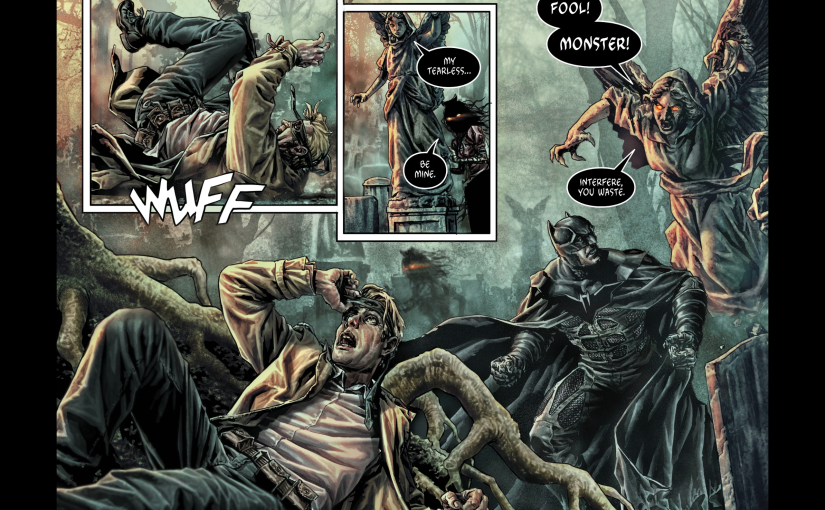
I reread the all three books of Batman: Damned in one day, and still struggled to be confident in my interpretation — until the start of my fourth go-around when I realized that the narrator implies that the hero is in hell, and that his quest is more about finding himself than finding out if the Joker is truly dead: “Literally bloody hell. I say that, havin’ a knowledge of it. An’ the depths we’ll go to ESCAPE it.” (If you’re curious about the heavy-handed Britishness of the quote, it’s because narrator is Constantine, who’s more a vehicle for Azzarello’s voice and style than anything else. That’s all I have to say about that.)

Once I accepted that Batman is in hell, and that the myriad of supernatural DC characters were there just to add to the story, the entire plot that follows from that moment in issue one onward became much more straightforward. The laws of storytelling become more flexible, leaving Azzarello and Bermejo plenty of room to craft creative transitions and moments of poetry.

The “Batman is actually dead this whole time” interpretation explains all the abrupt transitions in setting from hotel to cathedral to underground rap concert to graveyard to magic club. It means that the moment Batman falls from the bridge (which is what we’re misled to think actually happened) is really his descent into hell and the beginning of his judgment. It means Batman died on top of trash bags in the street after the Joker stabbed him, and he’s touring hell awaiting the judgment that finally comes in issue 3. Once he’s in the G.C.P.D. morgue, Batman fittingly decides his own fate, finally surrendering himself to death.

This storytelling technique isn’t what makes the books of Damned mythology or even part of the comics canon. It’s Batman’s true foe in the story: not the Joker, but Desire and Fear of Desire, the character otherwise known as Enchantress. She is a demon who strikes a deal with young Bruce: “no tears for fears.” This serves as Batman’s origin story. She torments him his whole life — from childhood to manhood — like death trying to claim him, to get him to surrender. Her presence is associated with Thomas Wayne’s infidelity to his wife Martha, and Bruce’s discovery of how this torments his mother. Even when Batman “defeats” Enchantress, she ultimately wins in the end. No matter how strong the hero, no matter how much money he has, no matter how long his wang is, he will always have to surrender to death.

Speaking of heroes, Lee Bermejo’s art is a herculean achievement. I place him in the elite rank of Alex Ross, and would even dare to say that I prefer Bermejo’s renditions of the human form, cityscapes, facial expressions, action sequences, and landscapes to those of Ross. I was especially impressed by the way he conveyed the aftershock when Harley Quinn’s bombs went off in Gotham, and how he illustrated the confusion Batman experienced while drugged. He made this story horrific.

It’s a real shame that people didn’t have more patience for Damned, and it’s an even bigger shame that the executives at DC cowered from the clear momentum that this book had.

Review of CATEGORY ZERO #1 from Scout Comics

Scout Comics has been on a winning streak lately. With their series THE MALL being optioned for TV, and April’s premier of ELECTRIC BLACK generating buzz among readers and speculators, Scout has established itself as a powerhouse among indie publishers.

This week, Scout debuts a promising new series, CATEGORY ZERO, written by Adam Kiamil, with art by Ton Lima, and colors by Derek Dow. According to Kiamil, the creator, the target audience for this series is those “who grew up reading comics like X-MEN and HARBINGER, but whose tastes have moved away from the traditional superhero genre.”

What’s CATEGORY ZERO about?

Earth’s entire population is infected with the Strix virus. First discovered by scientists at Sanaxus research 20 years ago, the virus and its symptoms manifest in one percent of the population. At the onset of the virus, these “One Percenters” experience flu-like symptoms before abruptly developing superhuman abilities — either physical or mental.

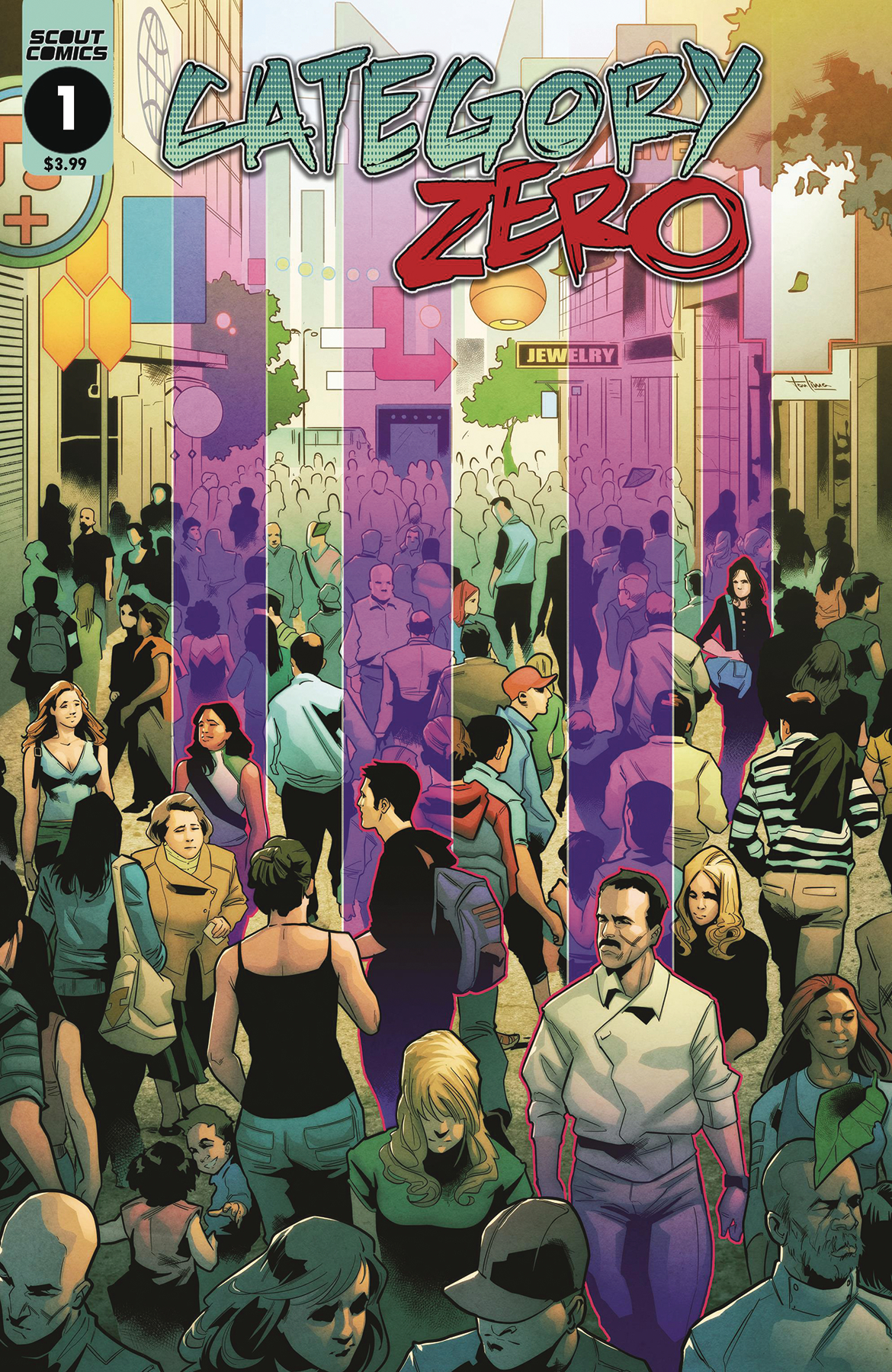
The clever cover of CATEGORY ZERO #1.

In most cases, these powers are harmless, but sometimes, One Percenters pose a threat to the general populace. To treat and study the virus, Sanaxus has developed secure research facilities where known One Percenters live together in suburban-looking communities. As always in the suburbs, things aren’t what they seem.

What’s issue one of CATEGORY ZERO about?

In the opening pages of CATEGORY ZERO, we travel back in time 20 years to meet Phillip Patterson, one of the original Strix researchers at Sanaxus. He has recently been promoted, but suddenly dies at the congratulatory surprise party celebrating his achievement.

Phillip Patterson in his final moments.

With his dying breath, Phillip confesses to his son, Jake (also a Sanaxus researcher), that “Strix isn’t what they say it is.” When Phillip says “they,” I assume he’s referring to Sanaxus, and that whatever they’re lying about will be the engine for the plot in CATEGORY ZERO.

In the present day, Professor Sarah Higgs delivers a lecture on the Strix virus to college students — a seamless way for Kiamil to provide context. One of her students, Neve (who will likely take on a larger role in the series following issue one) asks about her husband and his former professor, Leonard Higgs, a One Percenter receiving treatment at Eden, a Sanaxus facility.

After Sarah and her daughter visit Leonard at Eden, they stop by Arrowbank. While waiting in line, they encounter an ill-looking man coughing uncontrollably. His flu-like symptoms escalate until his hand tremors. Suddenly, the entire building is shaking as if there were an earthquake. Arrowbank collapses, presumably killing everyone inside.

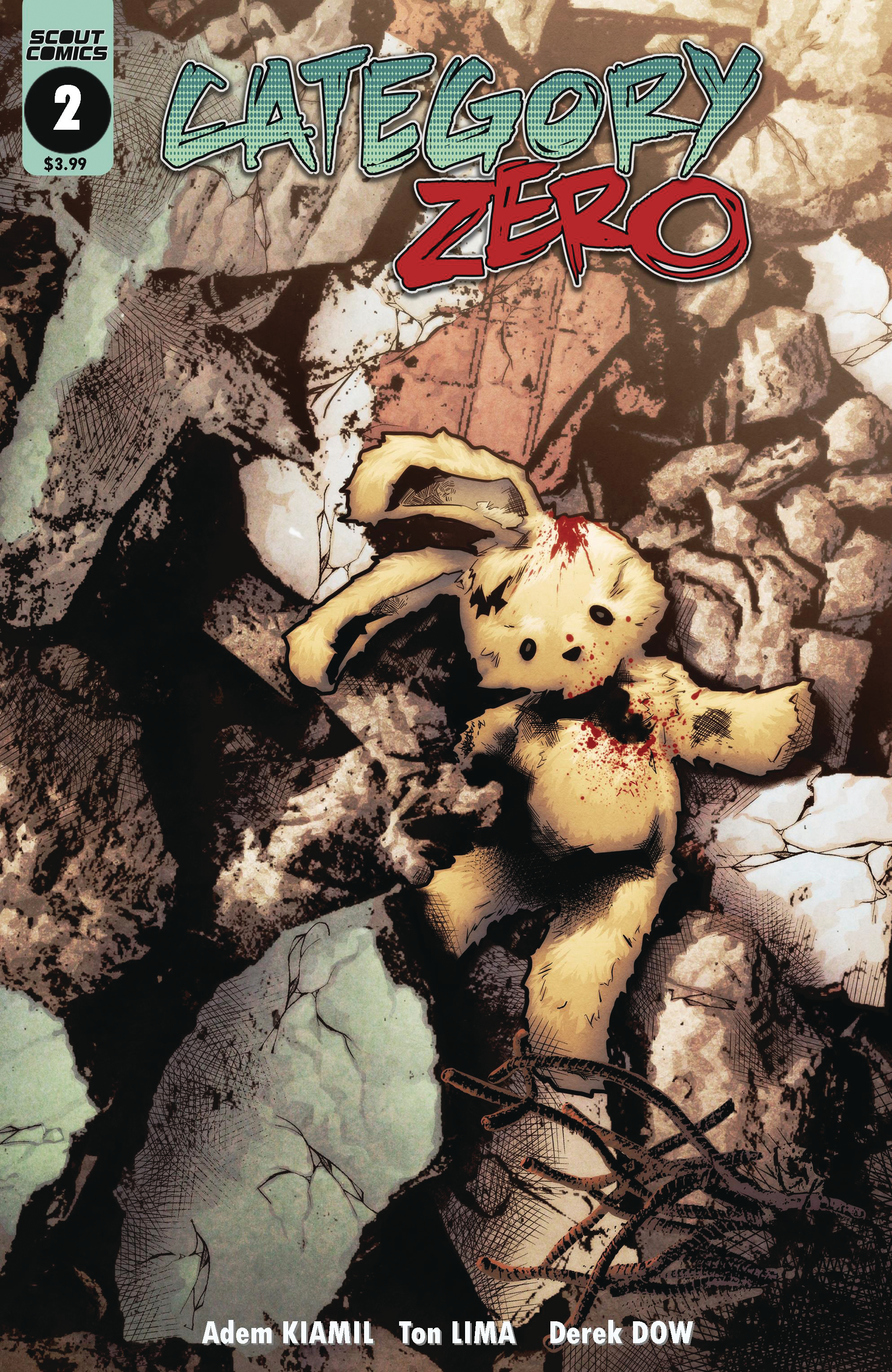
The cover for CATEGORY ZERO #2 is similar to the final panel in issue one.

How’s the reading experience?

In 2019, Americans are, more than ever, considering the experience of marginalized “others” — those who are always disadvantaged, sometimes poor, and generally not part of mainstream society. As such, One Percenters are segregated into isolated communities, further away from the rest of the population who struggle to understand them.

In this way, THE BEAUTY and X-MEN are taken up in CATEGORY ZERO; themes like social exclusion, mutation, viruses, and intervention by governments and corporations are at the forefront. All of this makes the story an ambitious undertaking. Unfortunately, that ambition doesn’t come through in the execution, which feels mostly flat.

The plotting and world-building are the strongest features of this series debut. I liked the multiple timelines in issue one of CATEGORY ZERO, and am curious to see how the past shapes the events I’ll witness as I continue to read .

Released covers for CATEGORY ZERO #3 suggest that Sanaxus has a hidden agenda for the Strix virus and the affected One Percenters.

At the dialogue level, however, the writing was sometimes corny — particularly in the scene where Sarah, Leonard, and their daughter reunite. As a relentless grammarian, I noticed that there were minor blemishes in punctuation and sentence structure; when comics don’t have an editor credited, this is often the case.

Art in CATEGORY ZERO

Generally, the art was impressive and unique. The triangular facial structure of the characters reminds me characters in SUPERIOR SPIDER-MAN by artist Mike Hawthorne. There were impressive backgrounds in larger panels, where the chunky lines gave the art satisfying weight and texture. The color pallet had a muted, sickly green color, which felt entirely appropriate. Overall, though, the art could be more detailed.

Should you invest in the CATEGORY ZERO series?

CATEGORY ZERO is a consistently-paced, somewhat satisfying read sandwiched by two cliffhangers at the beginning and end. I am slightly curious to see where the creators take this series. If the series benefits from more focus, editing, and plotting, I can easily imagine TV and film producers throwing money at the concept.

Rating

6.5 / 10

  • Solid storytelling
  • Timely themes
  • Immersive intrigue
  • Lack of attention to detail

Review of QUEEN OF BAD DREAMS #1 from Vault Comics

8.5 / 10 Rating

MADAME XANADU Homage Variant, Michael Kulata

What’s QUEEN OF BAD DREAMS about?

Set far enough into the future where flying cars are no big deal, QUEEN OF BAD DREAMS is about a woman who decides the fate of dream entities (called figments) who’ve “dropped” into the real world.

The hero of the story, Daher Wei, is the model employee at the Morphean Annex, the organization that handles all issues related to figments. As an Inspector Judge, she decides if the figments are reinserted into dreams, given residency in the waking world, or are neutralized.

Inspector Judge Daher Wei on the job.

Don’t sleep on QUEEN OF BAD DREAMS #1

In issue one, a particularly powerful figment named Ava escapes from the imagination of a man named Emerson Chase. He’s the son of an influential councilwoman, whose family has a complicated relationship with the Morphean Annex. For years, Ava’s protected him from nightmares, but she seems to have new priorities. Judge Wei’s job is to determine if Ava has enough agency to be granted a life beyond the confines of Chase’s mind.

Chase’s dream figment, Ava, has escaped into the world.

In issue two of QUEEN OF BAD DREAMS, we’ll likely learn more about Ava, why she escaped, and how Emerson Chase is one of those “Men who fall apart when you challenge their worldview,” according to the narrator, Daher’s ex-wife, Viv. The purpose of Ava’s character, it seems, is to say that certain figments have the same humanity as people — or even more. The QoBD series will be five issues long.

My opinion

Jordi Pérez (inks) and Dearbhla Kelly (colors) work together to create trippy, dreamlike art with a wobbly fisheye-lens quality.

Written by Danny Lore, the plot and relationships between characters are brimming with possibility. As a queer woman, I’m especially interested to learn more about Daher and Viv’s former marriage beyond the work-life balance issues. For such a unfamiliar world, the writing about it was clear. There was one scene, however, between Daher and her partner, West, that was tough to follow.

I’m looking forward to issue #2, releasing next week on May 29.

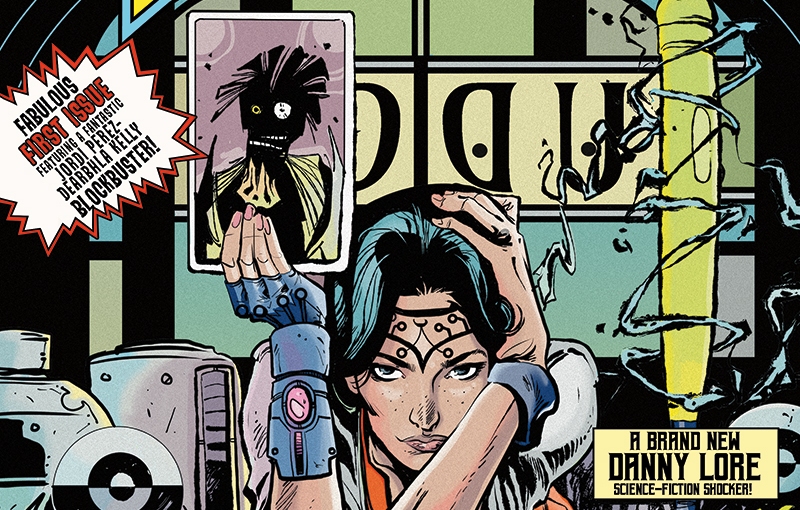
Queen of Bad Dreams Issue #2 cover

Review of 4 KIDS WALK INTO A BANK Chapter 1 by Black Mask Studios

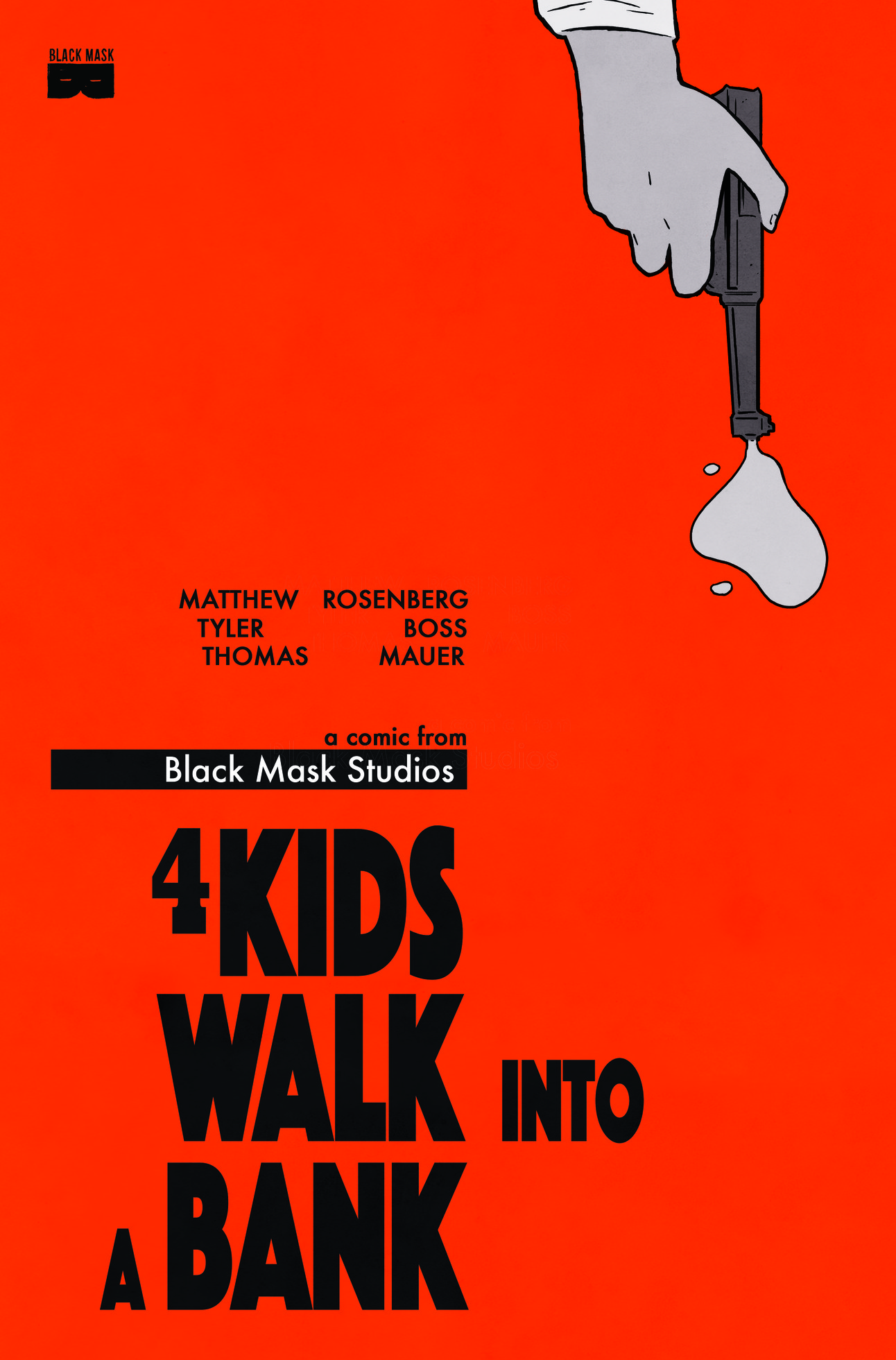
4 KIDS WALK INTO A BANK Stray Dog red homage cover

9.5/10 Rating

What’s 4 KIDS WALK INTO A BANK about?

The title, 4 KIDS WALK INTO A BANK, makes the series sound like the start of a convoluted dad joke. In actuality, 4KWIB is a well wrought crime / humor story written by Matthew Rosenberg (of UNCANNY X-MEN) about kids, the awkward middle-school years, friendship, family, and the bank heist of a lifetime. First published in 2016, Chapter 1 is part of the five issue mini-series, which has recently been optioned for the movies — and with good reason.

Why is this comic worth your time?

The first installment of this gloriously quirky 1980s caper has all the ingredients for a successful big screen adaptation that will remind readers of Stranger Things and Wes Anderson flicks.

In the first pages of Chapter 1, the four kids are playing Dungeons & Dragons in an ephemeral action sequence masterfully illustrated by Tyler Boss. By the end of the issue, they’re grounded in a strange reality where they’re spying on a bunch of ex-cons who saved them from some schoolyard jocks…and also just barged into one of their homes.

Rosenberg and letterer Thomas Mauer imbue each kid with a comically distinct personality, making me feel like I knew all the inside jokes and was part of the group. This doesn’t happen a lot. I just finished Y: THE LAST MAN — 11 years late, I know — and as emotionally attached as I was to Yorick’s journey, I felt like the dialogue for every character had the same wit and sarcasm, which was really just the voice of author Brian K Vaughan. Rosenberg’s writing doesn’t suffer from that monotony.

By the end of Chapter 1 of 4KWIB, you’ll have enjoyed some quality laughs, be in complete admiration of Paige (the group leader / badass wonder child), and need to know what the hell is going on with her dad and these unruly ex-cons. You’ll want to read Chapter 2 ASAP.