I usually don’t fall head over heels for stories built on the backs of multiverse concepts. And as far as falling head over heels for stories goes, forget about stories that try to milk sales from the sore teat of previously successful concepts — like the whole “Batman Who Laughs” thing.
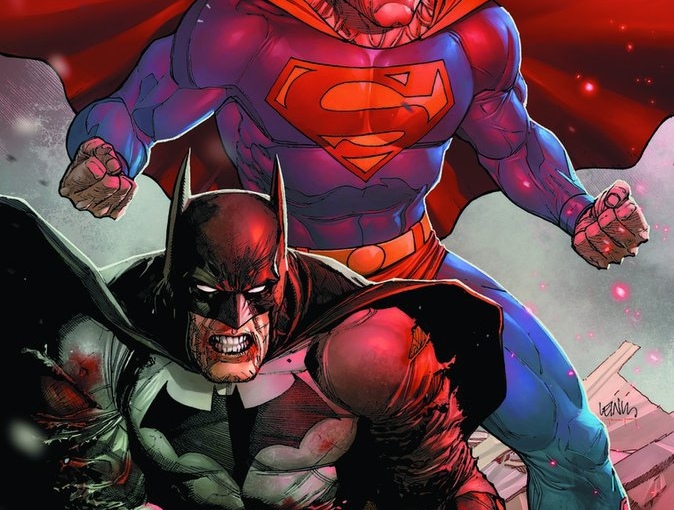
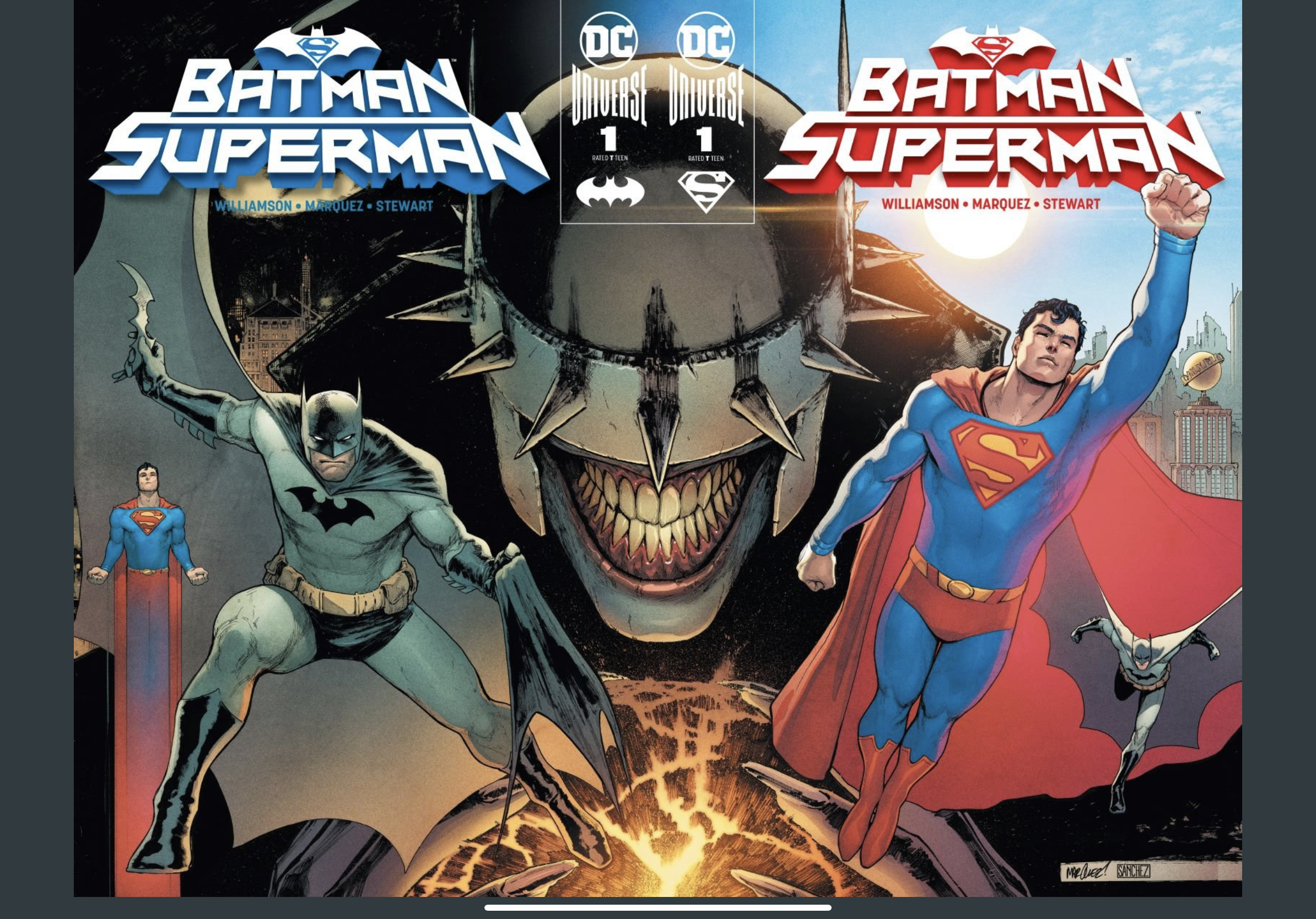
And yet…here I am, really stoked on Batman/Superman #1. Yes, Superman’s and Batman’s rockin bods and thick necks might have something to do with the allure, but mainly it boils down to great art and great writing.
Joshua Williamson seems uniquely capable of getting inside Superman’s and Batman’s psyches, and David Marquez is easily one of my top four favorite pencilers (ever) in comics. (That list includes Lee Bermejo, Ransom Getty, and Ryan Stegman.)
To my fellow reviewers who feel that Alejandro Sanchez’s colors are “flat” or “dull” or some other negative adjective, to you I say, HOW DARE YOU. The use of light and shadow, the clarity of the hues, the ethereal ghosts in Crime Alley?! Lower your expectations, please, because this dude is a coloring god. (And since I’m name dropping artists not associated with the book, I’ll randomly say that John Rauch is also a coloring god.)
Superman’s opening line — once you get past the whole Jimmy Olsen Does It Again bit — tells you what to expect, straight up. (This was especially helpful for me, A Person Who Did Not Read Batman Who Laughs.)
“From the moment we met, it was clear that Batman and I didn’t see eye to eye. But over time we learned there are some things we always agree on…We would never give in to the devil on our shoulder and hurt our enemies the way they hurt us. If we act like them, we become them.”
Superman
Thinking about how heroes would make the best villains if they decided to become that harkens to the whole With Great Power Comes Great Responsibility Thing, but in a very moody way that is Very DC.
Here’s the nuts and bolts of the whole story: Batman Who Laughs escaped to Earth-0 and wants to use serum on infected batarangs to make DC’s roster of heroes villains. The details don’t really matter. That’s just a Plot Point, and I’m more concerned about Storytelling.
This Whole Situation makes Batman and Superman wonder if the other is infected. Watching Batman ask Superman all these hypothetical questions about what Superman would do if Batman Suddenly Went Bad was…really endearing, like you were watching an odd couple whose love has somehow survived decades and decades and decades. Batman, the cautious planner, Superman, the optimistic live in the moment kinda alien/guy.
All this philosophical musing about the merits of a hero really pops, thanks to colorist Alejandro Sanchez. That scene where the other Superman “dies,” surrounded by the pulpy corpses of his Justice League comrades, is horrifying! My favorite panel: an extreme closeup of Superman mid-“death.” Watery, red eyes. Blood pouring down his chiseled cheekbones. Sweaty hair and shiny lip. Pain. Perfection.
And without David Marquez, where would Sanchez’s colors even be? Showing off his impeccable knowledge of meaty man anatomy, he creates methodical shots that are worthy of a Best Cinematography Oscar. (Why don’t the Eisner’s have a Cinematography Award???) Even the small stuff shines, like the perfectly rendered hands, especially in that one panel of Superman flying to his “death.” The majestic swoops and sweeps of Batman and Superman’s capes, responding to wind and gravity. All that comes together in the two page fight scene against the drones, with the dynamic poses and laser eyes.
Aaaaaand then Shazam Who Laughs shows up? Okay, whatever.
Williamson makes this Year of the Villain cliffhanger resonate with a Batman quote that puts us right where we started. “If heroes ever started to act like our enemies, we’d be better villains than they ever were.”
This comic has tight storytelling, world-class art, and asks a troubling question about being human. Next issue, please.
Naturally, it was raining the day of the Cates-Stegman signing at Midtown Comics downtown. It was a few blocks from where the towers fell in 2001.
I claimed my spot in the line. Person number 145. It was 5:50pm. I’d been there since 5, and the signing (officially) went from 6-8pm. I wouldn’t leave until 10:37pm.
The line wrapped around an entire lower Manhattan block. (Cates took a video, and at the 1:07 mark, I’m screaming like he’s all 4 of the Beatles.)
Over 20,000 people have watched me make this stupid face.
The masses were told that we could get 3 signed copies of whatever Cates and Stegman worked on together. A lot of people brought Venom comics, but I was there getting all the main covers signed for Secret Society on my heroic quest to bring a taste of Manhattan to South Florida.
Sketches cost $50 (cash) to be paid up front to Stegman. Here were my ideas for the cover:
Donny and Carnage getting married
Carnage with a tattoo of Donny Cates’ face
Cates and Carnage on a(n emotional) roller coaster
I read CARNAGE: MIND BOMB the morning of the event since Donny Cates has cited it as an influence for his script for ABSOLUTE CARNAGE. I had a canned conversation starter that I was gonna unleash on him. Something like “Yo, MIND BOMB is messed up!!!” (It really is. You should read it.)
I was in line for 4 hours. During that time, I thought about a lot of things, like Carnal Knowledge would make a great name for the Steg-Man and his Amazing Friends podcast. I talked to some fans, like this really handsome guy with a Carnage tattoo on his forearm, who also happened to be drinking beer from a paper bag. I talked to some kids, who were mostly just hangry. We were all making history.
As night fell and I approached the front of the line, I was mere feet away from Donny’s Dark Queen/fiance/cofounder of Devil’s AdvoCates, Megan Hutchison. She was, of course, wearing all black and smoking and looking very cool. I also thought of what I’d say to her. When the time came, I said, “Killer job on the cover for this!” since she colored Donny’s inks.
After I said this to her, a group of 20 people (including me) were herded up the stairs to the shop. Donny and Ryan said they needed a 10 minute break. The suspense continued to build, and I was convinced they had carpal tunnel by now.
Good things come to those who wait. As I approached the signing table, my heart wasn’t beating faster than usual, which surprised me. Maybe it’s because I felt like I knew Donny and Ryan from their Twitter, where they’re effortlessly themselves.
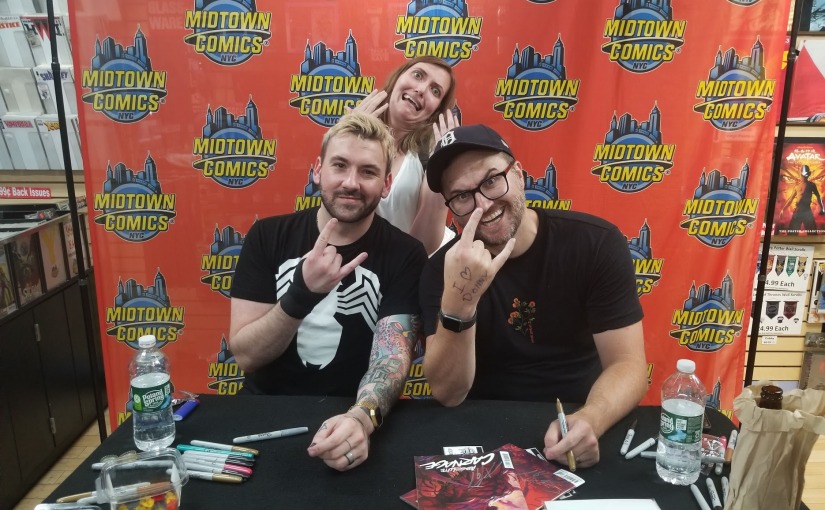
The first thing I said to them? A lie. “So when I told Megan nice job on the cover art, she actually told me that Chip Zdarsky wrote and drew all of ABSOLUTE CARNAGE.” Cates said, “HOW DARE YOU” or something like that. Then I forced both of them to take a “silly and serious” photo with me.
Silly.Serious.
I forced my non-comics-reading coworker to attend the signing with me so we could get more grails sent to the shop for y’all. When it was his turn, he made a comment that they must be tired, and they all joked about a certain way to get around that… (Only in New York.) The guys were entertained, so Ryan decided to give us a quick headshot sketch of Carnage — even though they cost everyone else $50, and we didn’t even ask.
After it was all said and done, I thought, “Midtown employees are American heroes. They’d been standing there for hours, sorting CGC paperwork, answering our repetitive questions. “
The whole experience reminded me of why I love comics. Creators really do engage with fans, and the community is SO diverse. Don’t let #ComicsGate tell you otherwise.
Comics are basically an intellectual property factory for the more “respected” mediums of TV and film, and I know that ABSOLUTE CARNAGE will reach a bigger audience (AKA China) in the coming years. I’m just happy to have been there since the beginning.
I’m not really sure about the legality or ethics of this, but here we are. I’m about to break down each individual page of the 60-page epic that Donny Cates and Ryan Stegman bestowed unto us yesterday.
I feel compelled to do this.
On Twitter, a lot of people are asking Cates to justify them having to pay $7.99 for this monumental, triple-sized issue. That’s partly why I wrote this, to show how ridiculous it is to demand that from the creators of a book which gives readers so much.
For those of you who have a digital copy of ABSOLUTE CARNAGE, or were unable to get one because of the ridiculous demand for Marvel’s big event book, know this: it feels satisfyingly weighty in your hands. (Yeah, OKAY, “That’s what she said”…but I’m serious.) This is just one of the many indicators that this book is a heavy hitter, and will have a massive impact on comics for years to come.
1:50 variant cover by Nick Bradshaw
If you haven’t read all of Stegman’s and Cates’ VENOM run, and are also unfamiliar with the million crossovers that give context to this story, don’t worry. Marvel’s blogger minions wrote this helpful primer to prepare you: “As Carnage, Cletus’ new goal is to set free Knull, the God of Symbiotes. All he needs to do is track down anyone who has ever worn a symbiote and steal the latent Knull codex from their bodies.” The thing is, a LOT of A-list characters in the Marvel universe have bonded with a Symbiote.
If you don’t make it past this introduction, there are two things I want you to know about this landmark piece of comics literature: Cates’ words and Stegman’s expressions set up really moving moments that tell you exactly who Eddie Brock is. The other thing? This is the coolest Spider-Man since Todd McFarlane, hands down. (And JP Mayer’s substantial inks are a huge part of that success.)
And there’s actually one last thing I want to tell you. This review? FULL OF SPOILERS. But if you’re picking up a book with Carnage in it, can you really be THAT afraid of anything, especially spoilers…?
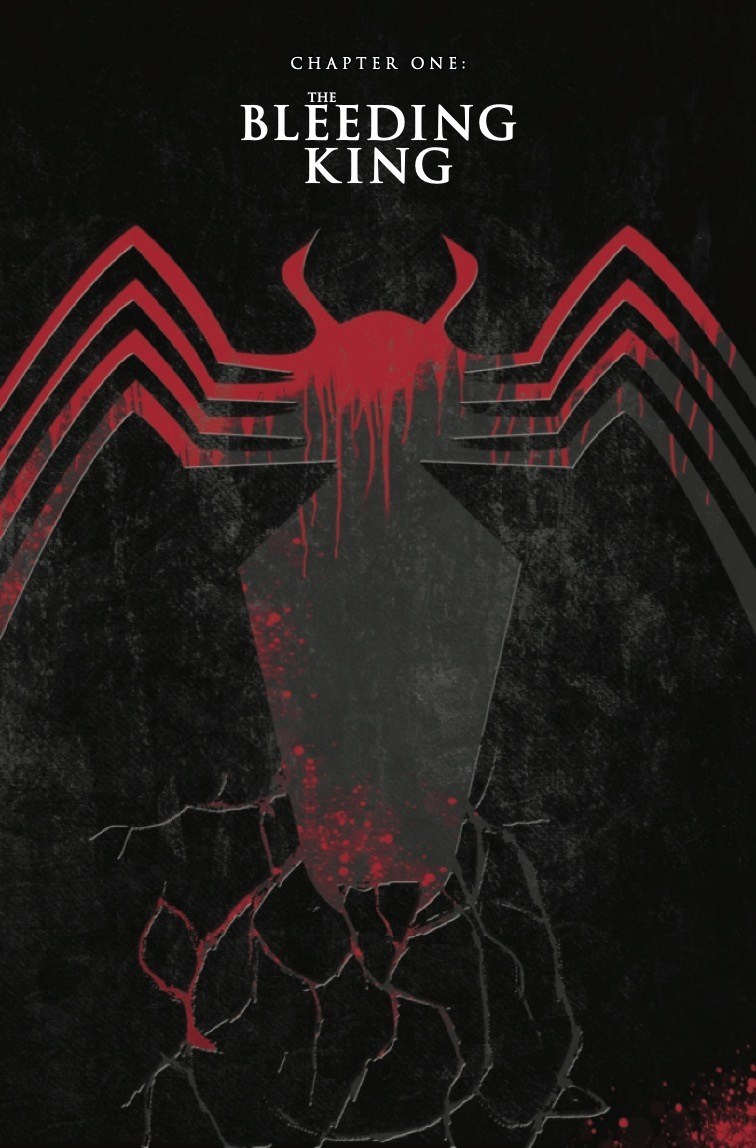
Chapter One “The Bleeding King”
SUMMARY: Carnage is back, and he is on a mission to communicate directly with Knull, the god of darkness, death, and Symbiotes.Eddie Brock is going to need to become Venom, and ask for Spider-Man’s help, if he wants to survive this.
Act One, Chapter 1: Pages 1 – 5
1: Eddie is talking to Dylan, his nine-year-old “half brother”…who is actually his son. This provides a seamless backstory for Knull’s history and plan to doom all things “living and bright.” This is really just Cates talking to his readers, catching them up on what’s happened, and telling them what’s to come. Knull is the god of Symbiotes and ruler of the abyss. Before the beginning of life, he controlled symbiotes with his mind to kill encroaching life — until the symbiotes rose up against him and imprisoned him.
2-3: When symbiotes bond with their host, they leave behind a little piece of themselves in their host’ DNA. This isthe codex. Symbiotes use it to communicate with each other about their host and reconnect to the hive, which is controlled by Knull. Eddie Brock tells Dylan that whomever controls all the codices can talk to Knull.
As we get all this critical backstory, rain falls from the sky as Eddie and Dylan move through the streets of New York. The way Stegman renders rain is better than life. The disorienting downpour creates reflections in the pavement that establish a hazy, ominous atmosphere.
4-5: Cletus Kasady was the world’s most notorious serial killer who rose from the dead to become Carnage. He was resurrected by Church of the New Darkness, a cult that worships Knull. (The cult name is so metal, SO Cates!) With a new purpose, Carnage is trying to collect all these pieces of Symbiotes.
Act Two, Chapter 1: Pages 6 – 13
6-7: Eddie Brock senses that they’re being followed in Times Square. We see a mysterious figure wearing a hat and coat trailing them. As they descend into the subway, we see the faces of miserable New Yorkers getting rained on. (From experience, I can say the way Stegman conveys this is VERY accurate…)
Page 6 of ABSOLUTE CARNAGE, courtesy of a Marvel preview published on AiPT!
8-9: Disguised and hidden in human form as Cletus Kasady, Carnage pushes Eddie and Dylan onto the tracks.
10-11: We discover that Eddie’s Symbiote was actually the one following them. He saves them by smashing into the train, preventing it from running them over. He also derails and crunches a subway car full of people, which doesn’t really help the already terrible public opinion of Eddie Brock.
Stegman’s pencils show the subway train getting derailed by Venom.
12-13: Eddie is now Venom. His “Other” — which is how Eddie refers to his Symbiote — warns him Cletus/Carnage is here.
Act Three, Chapter 1: Pages 7 – 22
14-15: The first thing Carnage says to Venom: “WELL HELLO, DADDY!” This reveals that Carnage knows about the real relationship between Eddie and Dylan, and will use this knowledge to make Venom weak. Carnage and Venom battle underground. Eddie’s Symbiote knows that Cletus is wearing the Grendel Symbiote — which belonged to the lethal dragon they fought with Rex.
“WE’RE A GOD NOW!”
– Carnage
16-17: Eddie’s Other seems more self-aware than Eddie himself amid all the chaos. It recognizes that Carnage is too powerful, and that Eddie needs to put Dylan first. As Carnage towers over Eddie, he snarls: “There is no fighting this. This is the end of the light. He is coming! God is —” To shut Carnage up, Eddie grabs the third subway rail — the one charged with electricity.
18-19: In an imaginatively drawn, dynamic splash page shot from bird’s eye view, Eddie shocks Carnage (and himself). We see the hyper-sensitive Symbiotes briefly split from their hosts, becoming wispy, etherial tendrils. Carnage is reduced to nothing more than a splatter of blood and guts — and yet he’s not dead. The electric shock separated Eddie from his Other. The Symbiote now looks like a lost, vulnerable child. It reattaches to Eddie.
20-21: As Dylan and Eddie flee the scene, Venom places Eddie in a brief coma as he heals. The Symbiote autopilots them to their destination so they can ask for help in this crisis. Peter Parker’s roommate answers the door.
22: *clap* COMICS *clap* ARE *clap* BUILT *clap* ON *clap* CLIFFHANGERS. Cates sticks to this golden rule with a full-page reveal of the SEXIEST and MOST JACKED Spider-Man ever. Seriously, ya’ll, this man is the pinnacle of masculinity.
Stegman’s pencils for page 22.
Chapter Two: “The God Son”
Yes, the title sounds metal as hell, but it’s actually a pun (and potentially, some foreshadowing). In this issue, we meet Peter Parker/Spider-Man’s godson, who — like Eddie Brock — has the latent codex inside him.
SUMMARY: Spidey, Eddie, and Dylan meet in a diner to discuss the situation at hand, and how they’ll handle it. They’ll find a potential solution to Eddie’s Carnage/Symbiote problem at the end of the chapter— but is it worth it??
Act One, Chapter 2: Pages 23 – 27
23: As the heroes sit in a diner, casually mulling over the situation, I just couldn’t help but relish in the fact that Spidey is in public wearing his costume, classically deflecting the gravity of the situation with humor.
24-25: There is clearly some awkwardness between Eddie, Spiderman, and Dylan. The boy leaves the table so that Eddie and Spider-Man can speak in private — about Dylan.
26-27: The emotionally intelligent and vulnerable Spidey implores Eddie to tell Dylan the truth about their relationship. He knows a thing or two about growing up without knowing who your father was, which is a hard reality for boys in need of a role model who looks like them.
Just as Spider-Man is at his most persuasive, and Eddie is about to seriously consider telling Dylan the truth, the mission at hand comes back into play. (Of course.) Eddie notices something interesting on the news, and stops listening to Spider-Man. This is a GREAT STORYTELLING AND CHARACTERIZATION MOMENT DONE BY CATES. It underscores how Eddie uses the crisis at hand as an excuse to protect Dylan from knowing about his real identity as Brock’s son.
Act Two, Chapter 2: Pages 28 – 34
28-29: The news broadcast shows a mass grave of bodies piled high, all without spines, found in Jersey. (As if we needed any more evidence that Jersey sucks…) **TAKE NOTE THAT THE BODIES ARE ARRANGED AT THE CENTER OF THE FAMILIAR SYMBOL THAT CARNAGE MADE IN THE EARTH.
30: We learn that the grave is full of people who’ve worn Symbiotes and died. This is a message to Brock from Carnage. As Eddie fights for control of the TV remote so that the cafe manager doesn’t change the channel, we see how unlikable Eddie can be on first impression.
31: This is “A message that says it doesn’t matter if you’re dead. You’re still a target.” As Eddie emphasizes this, Spider-Man’s spider-sense goes off. And let me just lay this on the table: STEGMAN DRAWS THIS BETTER THAN ANY OTHER ARTIST IN SPIDER-MAN’S HISTORY.
32: His spider-sense was triggered by average crooks trying to rob the diner. Compared to the end-times implications of Carnage’s return, this trivial robbery REALLY puts things into perspective.
Ryan Stegman’s iconic pencils for an action panel in Chapter Two of ABSOLUTE CARNAGE
33-34: After Spider-Man squashes these petty thieves in a stylized action sequence from Stegman the pencil god, Eddie seems jealous of Spidey’s relationship to the public, how they cheer for him. The scene changes to Rex Strickland’s safe house. We learn that Maker (a creepy/morally suspect Reed Richards from another dimension) has already created the machine that will extract the Knull codex without killing the hosts.
It seems that Maker and Eddie Brock have an aligned interest.
Act Three, Chapter 2: Pages 35 – 38
35-36: These panels are all the proof you need if you were ever wondering why you see Clayton Cowel‘s name all over your favorite comics. His letters are another important tool of characterization. You can hear how cold and technical Maker speaks by how orderly and stiff the font is when compared to the mildly italicized/all caps bold font of Eddie and Spider-Man.
Spidey’s gestures are another reason why Stegman’s Spider-Man is the coolest thing since Todd Farlane’s innovation with his character design. Preserving the thick musculature and expressive eyes of McFarlane’s Spider-Man, Stegman evolves the character design with a more flexible body, agile musculature, beefy neck, strong jaw, and attention to detail — you can see the outline of Peter Parker’s ears protruding from the mask. No one gets anatomy quite like Stegman these days.
37-38: The involvement of Parker’s godson and Eddie’s son, Dylan, connect the story to a younger audience, the next generation of comics-makers. This is a huge reason behind Marvel’s success. They don’t make any mature content — like DC with their Black Label (formerly Vertigo) — because their content effortlessly engages all ages. Younger readers are generally pulled in by the humor, imagination, and simple morality of the story while older readers are attracted to the intricate plots, choreographed violence, character wisdom, and tone/symbolism of the story.
Now that we’re done with that tangent on why Marvel consistently holds the dominant market share in the comics world, the Maker offers for Eddie to test the machine. This is a win-win-win, for Maker, Spidey’s godson , and Eddie.
Chapter Three “The Long Red Dark”
Summary: Spider-Man and Venom head to the Ravencroft Institute for the Criminally Insane to free “Red Goblin” Norman Osborn before Carnage can get to him first and taps into his codex.
Act One, Chapter 3: Pages 39 – 45
39: Norman Osborn sings a chilling song about squashing a spider that shows the state of his mental derangement. Stegman’s consistently moody rain continues to set the tone in an eerie establishing shot of the institute.
40-41: Bloody carnage drips down the pages, framing each panel. At the bottom of the page, we see the bloodshot, criminally insane eyes of Norman Osborn. Frank Martin’s colors really sell the intensity behind those eyes, as they bulge from Norman’s twisted visage. He also executes believable lighting in an upshot of the guard, John Jameson, discovering Spider-Man and Venom sneaking on the wall.
Stegman’s pencils for the best panel on page 41.
42-43: It’s established — for those who don’t know — that John also has powers as a werewolf. As they’re talking to each other about how to sedate Osborn before opening his containment cell, John is suddenly taken over by Carnage.
The final panel on page 43 is easily the most disturbing panel in the entire comic. It conveys the pain that Carnage can inflict on others. It shows how Cates has mastered the vocabulary of insane people — and shows how deep the author can go into the minds of his characters.
Act Two, Chapter 3: Pages 44 – 48
44-45: As Carnage enters, the color of the panels becomes decidedly evil, reds and blacks dominating the pages, Symbiote tendrils oozing from John’s eyes. Completely devoid of control over his own body, John shoots Osborn’s cell, triggering the alarm. “God is coming.” Venom is hypersensitive to loud sounds, and is briefly incapacitated.
46: Leaking his Symbiote into the prison cells, Carnage adds to his army. These Symbiote hosts break free form their prison cells and march behind Carnage.
47-48: Eddie fires John’s gun at the alarms to stop the noise. This is the most innovative display of motion I’ve ever seen in comics. With the gun in the foreground, we see the speed-lines, kickback, and smoke. Spider-Man webs John so they can prepare to meet Carnage.
Act Two, Chapter 3: Pages 49 – 60
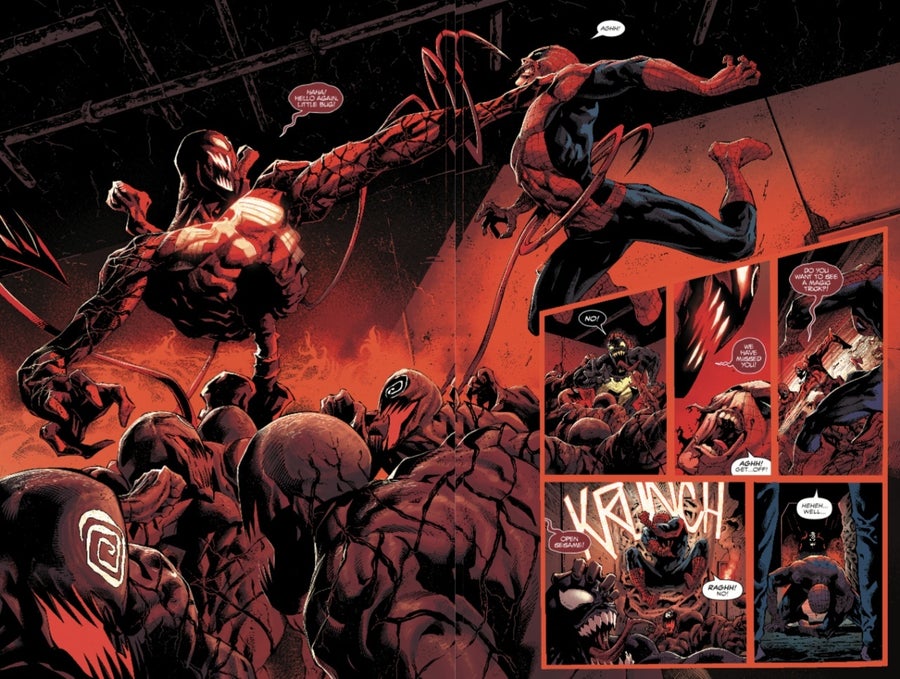
49-50: This all-consuming double-page splash of Carnage and his converts charging toward Spider-Man and Venom would make the perfect T-shirt print. Hear that, Marvel? Yet another opportunity to make money!
51: It’s pretty clear that Carnage is here for Osborn’s codex, always watching and waiting to strike at the right time. Spider-Man and Venom must try to save Norman Osborn from being entirely consumed by Carnage. Spider-Man establishes the mood perfectly when he says, “UGH…” in the final moments before Carnage.
52-53: This is another important characterization moment for Venom. Eddie defines his relationship with the Symbiote and their long, complicated journey. His alien Other gives him pain, and pain is important part of growth.
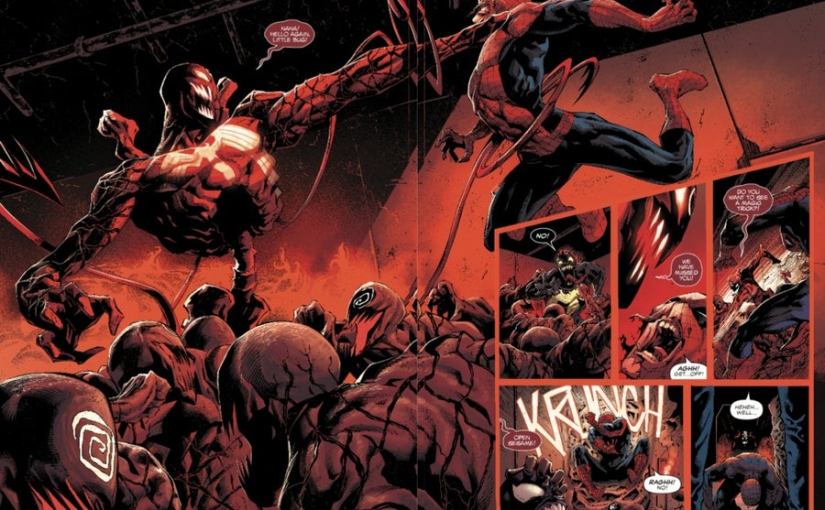
54-55: As they battle Carnage and his army, Carnage grabs Spider-Man by his throat one of the most compellingly illustrated double-page panels in the history of comics.
Stegman’s original art for ABSOLUTE CARNAGE is being sold, and you better believe this will go for a lot of money.
56-57: Spider-Man and Venom need to break Venom out from his cell, while simultaneously holding back Carnage and his army of obedient Symbiotes. Venom poignantly says, “Don’t be clever, be strong!”
58-59: The layout of panels for page 58 is yet another demonstration of how expansive Stegman’s imagination is. Spiderman’s fist repeatedly hits into the steel door with blazing speed, as we get frontal perspective of him and Venom fighting to get the hell out of Ravencroft. Venom can’t hold the door much longer, and we see Carnage about to devour Norman Osborne.
60: At last, Carnage claims Osborn. Cates closes out this legendary issue with a playful, yet haunting quote from Carnage: “I came here to make friends“.
Norman is Carnage’s puppet.
Anyone who Carnage controls is his puppet, and it will be a terrifying journey to see how he abuses that power in the issues to come.
Geopolitics, genocide, drugs, religion, corporate entities, Magneto — House of X #1 has it all. This is the kind of story that requires you to pay attention.
That one promo image for HOUSE OF X that you’ve seen 5,000 times.
The Most Important Things from HOUSE OF X #1
Humans of the planet Earth. While you slept, the world changed.
Professor X, epigraph
What is Krakoa?
Krakoa is Charles Xavier’s perfect mutant habitat, a garden of Eden with no snake, no fruit of knowledge, no Eve, no Adam — and especially no God. The island is the seat of the sovereign mutant nation-state established two months ago.
Cyclops says that “New beginnings demand a wide berth.” In the opening pages, we see X-Men planting flowers around the world over a five month period. They’re planting roots in the natural world to grow the infrastructure of their sovereign mutant nation.
Only mutants can access Krakoa. Advantageous gateways allow mutants to travel all around the world via the Krakoan ecosystem, but only mutants can access those portals. If humans are present, the gateway grants or denies permission for them to enter — but only if a mutant asks on the human’s behalf.
Make no mistake: Charles Xavier is creating a distinct culture, with its own language, land, economy, environment, and drugs.
The Flowers of Krakoa
This chapter title refers to the flowers/drugs that allow mutants to access different environments and states of consciousness unavailable to humans.
We learn that Xavier acquired a pharmaceutical company to produce pills that enhance the immune system, lifespan, and mental health of humans exclusively.
This sets up an interesting contrast between humans and mutants. Mutants: natural (flowers), community-centered. Humans: synthetic (pills), self-centered.
Krakoa Pacific
The introductory pages provide a geography of Krakoa, with indicators to 12 key locations.
According to Dr. Gregor, who is a pretty foundational character in the series, humans only have 20 years left before extinction.
Pan to outer space, where we see The Forge — a space station shaped like a giant Sentinel head. This outpost will help humanity “survive the coming days” in accordance with the Orchis Protocol (explained below).
Orchis Protocol: Build for Doomsday
This protocol is a response to a unique scenario when human population is threatened with extinction, the moment when natural selection finally chooses mutantkind over mankind.
The word “Orchis” is derived from Greek for “testicle.”
Three triggers cause this doomsday scenario, and they’re distinctly political:
Population: mutant gene rates are escalating
Financial: Charles Xavier acquired the seventh-largest pharmaceutical company in the world to make cure-all pills, a move predicted to destabilize the industry and provide him a unique advantage
Territorial: the nation of Krakoa is established
After this context, we see mutants obtain a copy of the combined database from 2 smartest people in the world. They are confronted with the Fantastic Four upon their escape. The contents of the data are unknown, and it makes a solid cliffhanger.
Damage Control
There is a corporate entity weaponizing Iron Man’s and Mister Fantastic’s technology. They add this ownerless intellectual property to an archive of similar assets where there is no clear chain of custody over that intellectual property.
Scott Summers/Cyclops tries to diffuse the situation with the Fantastic Four. using it as an opportunity to state Xavier’s politics. This moment draws an interesting and deliberate line between Marvel’s heroes and their ideologies.
Omega Level
The book ends by suggesting Magneto finally has his chance to be a god.
HOUSE OF X variant covers
Omega Level mutants are an elite class of the world’s most powerful mutants, of whom the Krakoan state is especially protective. Magneto is one of these rare beings.
Charles Xavier has made you an offer — one full of grace and brotherly love — but one that is also written in stone. This is not a negotiation. Things will be different now, and the sooner you realize the finality of your situation — and the inevitability of ours — the sooner you will be grateful for the things we are so generously giving to you.
Magneto
Mutants are the new gods, so it’s fitting that the ever-dramatic Magneto needed to make this statement in Jerusalem, the birthplace of the three Abrahamic religions: Islam, Christianity, and Judaism.
Time is a Flat Circle
The book, after starting with a quote from Charles Xavier, ends with a Magneto quote.
I have a new word for the lexicon of man: KRAKOA. And in the future, when you speak it, make sure you do so softly and with proper deference. For we will be listening.
Magneto
This speaks to the unity of mutants, and also makes the reader question just how aligned Xavier and Magneto really are. Would Xavier threaten humanity this blatantly? Is he already doing that?
HOUSE OF X & POWERS OF X Reading Order
“Two Series That Are One.”
House of X #1
July 24, 2019
Powers of X #1
July 31, 2019
House of X #2
August 7, 2019
Powers of X #2
August 14, 2019
Powers of X #3
August 21, 2019
House of X #3
August 28, 2019
House of X #4
September 4, 2019
Powers of X #4
September 11, 2019
House of X #5
September 18, 2019
Powers of X #5
September 25, 2019
House of X #6
October 2, 2019
Powers of X #6
October 9, 2019
Rating 9.5/10
Jonathan Hickman writes a unique premise that engages a lot of contemporary social and political issues.
Incredible graphic design from Tom Muller.
Bright and luscious colors from Marte Gracia softened the heaviness of Pepe Larraz’s lines, creating art that is on par for Marvel.
At roughly 55.5 million views, “Keyboard Cat” is one of the most popular videos on YouTube. Though it’s been over a decade since that glorious clip was uploaded, Keyboard Cat speaks to an enduring trait of American culture: we love to watch cute animals do cute things.
When cats are involved, people will pay attention. Just ask Lying Cat, from Brian K. Vaughan’s critically acclaimed Saga series. There is another promising addition to the “Cats in Comics” canon with Strayed, releasing on August 14 from Dark Horse Comics.
What’s STRAYED about?
(No spoilers.)
In the world of Strayed, a military-industrial complex fuels a relentless hunt for resources across the galaxy. This campaign is helmed by the “Infinite race,” who colonize planets and upend the lives of their native population in the process.
Variant cover for issue one of Strayed by Dustin Nguyen.
In order to identify planets ripe for colonization, the Infinites enlist a cat named Lou for his powers of astral projection — which allows his mind to travel through space. He reports what he sees through a translation collar made by his loving owner, Dr. Kiara Rodriguez.
Both are working for the Infinites against their will, unable to leave until their mission is complete. For months, Lou and Kiara live in the confines of a top-secret military base somewhere in space as the Infinites pillage planets, kill innocents, and take what is not theirs. Unable to see each other freely, Kiara and Lou are essentially prisoners longing to be home where they can feel like family again.
The story climaxes when the Infinite leaders have found an alternate use for Kiara’s translation device. Will Lou and Kiara continue to work for the Infinites and be complicit in their crimes? Or will they risk their lives to break the chain?
The Writing in STRAYED
In issue one of Strayed, Carlos Giffoni’s writing gracefully balances violent depictions of colonialism with moving displays of love between a pet and his companion in life. There were so many tender, surprising, clever, frustrating moments that Giffoni wrote into issue one of Strayed.
Carlos Giffoni is a Venezuelan writer, musician, and video game creative director/producer currently living in LA.
Every debut comic needs to create an interesting world inhabited with compelling characters. Strayed does just that. Anyone who is passionate about their pet will attach themselves to Lou and identify with Kiara. Anyone who sees colonialism as a violent force of greed will want to rebel against the Infinites.
The Art in STRAYED
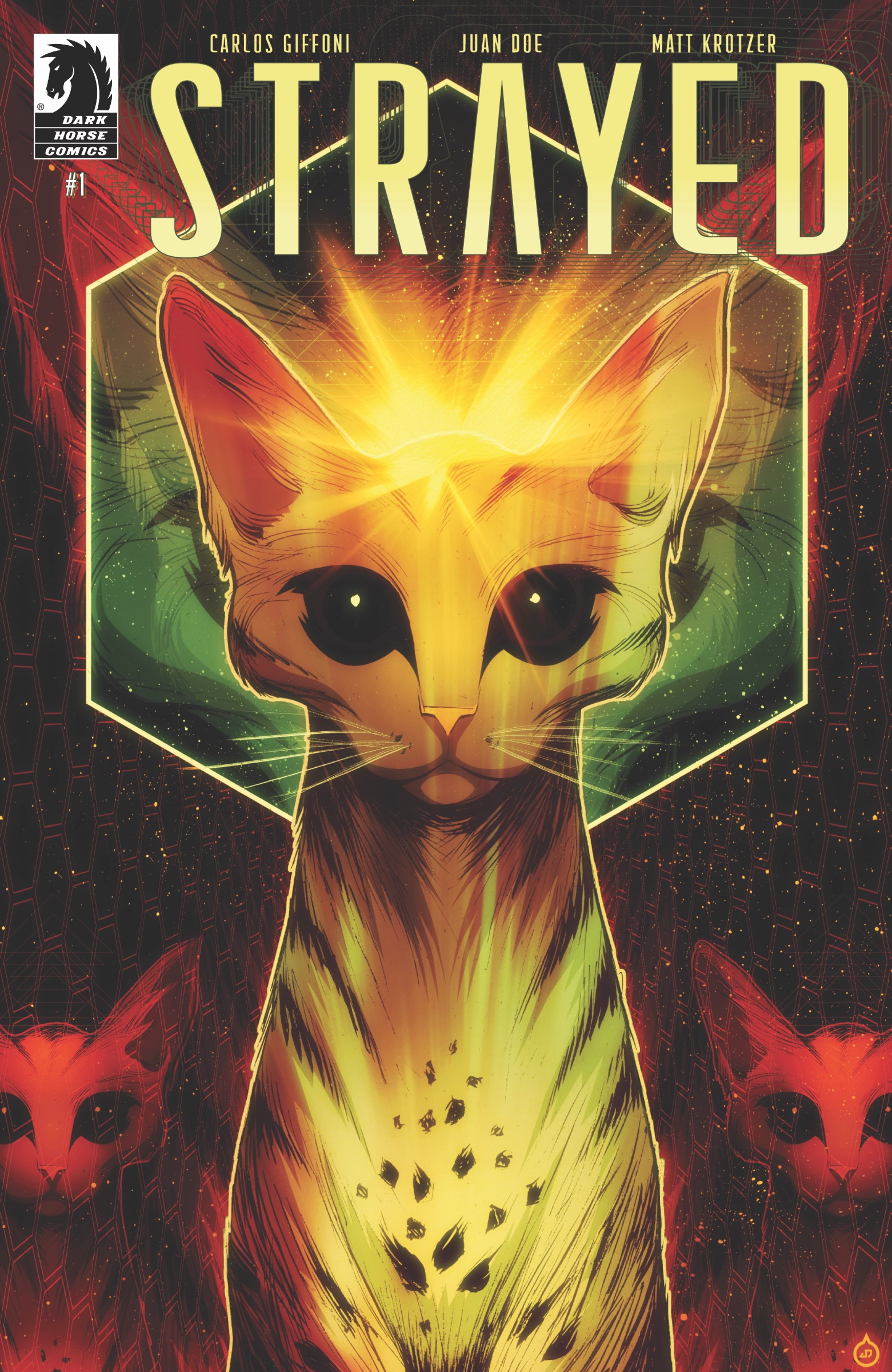
Artist and colorist Juan Doe’s unique style works perfectly in this outer space setting. (This was especially true during Lou’s vivid — and important — nightmare sequence in the middle of the book.) Lou’s face and eyes are highly emotive, expressing insight, fear, and love. The consistent palette of reds and greens make every gesture, feature, and detail pop, which enhances the reading experience.
Strayed Cover A.
My favorite show of artistry in Strayed is the non-traditional panel structure used throughout. Rather than favoring a traditional grid layout, Doe draws panels that use symmetry or hierarchy of size to convey the narrative. For example, the two-page spread for Lou’s nightmare shows his face in the middle, as the jarring events of his dream swarm around his head in organically-shaped panels.
Matt Krotzer’s lettering in Strayed is also worthy of praise. Always capitalized, the letters have variations in style, weight, and size. Krotzer uses a different lettering style for Lou to instantly convey that he uses a translation device to communicate, setting a pitch and tone for his dialogue.
Strayed Comic Rating
9.5/10
In STRAYED, Giffoni, Doe, and Krotzer create an emotionally and intellectually engaging world of characters, metaphors, and themes. The story is personal and political, cute and horrifying, strange and serious, all at once.
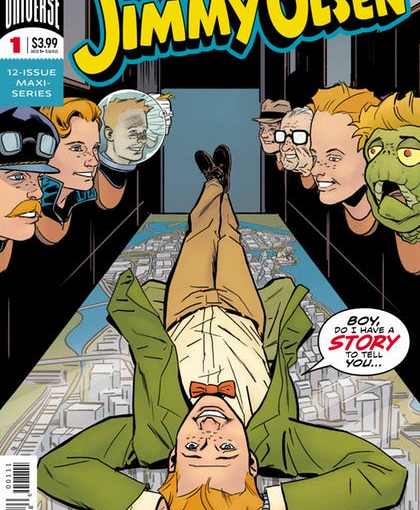
Who would’ve thought that a Golden Age character would become the poster-boy for “pivot to video”? Well, in Matt Fraction and Steve Lieber’s newest maxi-series, anything’s possible. Superman’s Pal Jimmy Olsen #1 is a hilarious collection of four related short stories provide a “bizarre tour of the underbelly of the DC Universe.”
The series opens with a family history of the Luthor and Olsen families, focusing on their role in shaping Metropolis. In a hilarious death sequence, Jimmy’s “great-great-grand-something” falls to his death after getting whacked with a shovel while disputing over the land that would be Metropolis. After this brief history, we see a standard day in the life for Jimmy Olsen: falling from outer space with nothing to break his fall…while metamorphosing into a giant turtle, thanks to a biomedical experiment. Though Superman tries to save his life and prevent major damage to Metropolis, he shatters The Monarch of Metropolis — a massive lion monument/tourist attraction erected by the Luthor family.
These shenanigans are fun, but the story really hits its stride in the second half. Jimmy’s space turtle fiasco costs the city and the Daily Planet, but the video of his fall is the only thing bringing money in for the publication. He’s too much of a liability for Metropolis, but he’s good for business, so Daily Planet’s publisher relocates him to Gotham. After moving in to his crappy new digs, it’s revealed that the Daily Planet published a front-page fake news story about Jimmy Olsen getting murdered!
For me, this was a comical story about the “long, slow death spiral” of print media, as the comic puts it. The “pivot to video” and clickbait trends are central themes to this story filled with wacky plot points. Fraction uses puns, witty wordplay, and slick sarcasm in a measured way that complements the strange subject matter. Steve Lieber’s art is just cartoony enough to match the funny script, and the colors heighten the Golden Age nostalgia while remaining crisp.
Credit: DC Comics
Rating 9/10
I need to learn more about the DC Universe, and this comic seems like an amusing tour de force. As a writer, I’m delighted to see comic creators working in a print-based medium address the challenges of the twentieth century. Although comics have adapted to the digital medium (with Comixology), the silver screen (MCU movies), and smaller screens (YouTube reviewers), it’s nice to see a traditionally print-based medium address its own reckoning in such a lighthearted way.
I assume that bored moms let their minds wander to the past, a time when they were less bored. If a bored mom is unemployed now, she might think about former career highlights. If her children are young, and if there are a lot of them, she might fantasize about the days when all she had to worry about was herself. If she’s unhappy in their marriage, she might think about more emotionally and sexually attentive boyfriends and lovers from the past.
From what I can see in issue #1 of Invisible Woman, Susan Storm is a bored mom. This is very clear, and yet I think I’m the first one to come out and just say it already. The creative team connects the past and present in issue one to explore Susan’s determination to break free from matronly routines.
What happens in issue #1?
Writer Mark Waid opens the series with a flashback to back to more than a decade ago, during Susan’s espionage mission for S.H.I.E.L.D.. What happens in that mission doesn’t matter at all. The scene merely exists to establish her relationship to her handsome partner, Aidan Tintreach (whom she calls Squarejaw), and their differing approaches to their line of work. He is fine with killing if it means surviving a mission; she isn’t.
That’s not where their differences end. Aidan/Squarejaw wants to be with his beloved “Stormy” romantically. She denies him that honor because she’s busy with the Fantastic Four. She’s also engaged to Reed Richards.
Fast-forward several years later, during which Susan doesn’t age at all. There’s some internal monologuing about she’s fine with being stuck in a routine before she is summoned to the C.I.A. headquarters. There, she learns that Aidan has been captured by terrorists/spies and is being tortured for intel. As he was being captured, he left a coded message: Stormy. How romantic!
Naturally, the old, white C.I.A. man tells her that she is not to intervene whatsoever. Naturally, Susan flies to Moravia, the fictional Marvel country where Aidan is likely being held hostage. Once she’s there, she meets the Black Widow, who bears a freaky resemblance to Nicole Kidman. Marvel just can not resist a crossover.
Rating 5/10
Until the series concludes, I’ll tag along for the distinct pleasure of looking at Mattia de Iulis’s art. It’s as if he’s spent his whole life analyzing the way light bathes objects and people. The way he renders fabrics — cloth, suits, cotton, denim, and leather — is overwhelmingly satisfying, better than real life. If someone from 1910 saw the realism of his art, they would have died from shock.
Mark Waid, if left to his own devices, might make this a story about Aidan and Susan’s chemistry, which might boil over into something physical when they inevitably meet again. Marvel, if left to its own devices, will not let that happen. Marital infidelity is not part of Disney’s (and by extension, Marvel’s) brand. I expect some lukewarm compromise between these two possibilities, filled with mostly action scenes.
It’s no secret that entertainment companies feel obligated now to make films about women. As a woman, I think this is a good thing. As a person who like quality entertainment, this can be a bad thing. It can result in shows made from a bland recipe of data analytics and market predictions. Netflix is known for this approach. And I fear that with Space Bandits, Mark Millar might be garnering a similar reputation.
Since 2017, Netflix owns Mark Millar’s creative properties. Anyone who’s finished a Millar comic since then has seen the Netflix brand logo at the end. The interesting thing is that Netflix came up with the concept for Space Bandits, while Millar is tasked with putting the story on shelves. I’m more interested in that business relationship — and what it says about the direction of the comics industry — rather than Space Bandits and its many clichés.
In this comic, protagonists Thena Khole and Cody Blue are notorious space bandits on the hunt for the ultimate reward: revenge on the men who betrayed them. In issue one, both women meet in prison after they were abandoned by their partners in crime and apprehended. To the audience, it will resonate with recent reporting on how women are getting screwed over personally and professionally by men. To me, it weakly accomplishes that. So far, Space Bandits seems to be a typical brains vs brawn story.
Millar suggests that he was filling a gap in the market with this comic. “In a world with a billion superhero properties and gloomy, rain-soaked dystopian sci-fi, there’s a gap in the market for sci-fi that’s upbeat and fun. I wanted to combine all this into a big, high-octane story.” His assessment of the market is spot on. His description of the story is not.
The only “big” thing for me in issue one is the 100-mile long dead lobster that is “being mined by thousands of the universe’s most dangerous prisoners” — including Thena and Cody. Whether or not this is Millar’s critique of the prison-industrial complex remains to be seen. Apparently, this crustacean floating in outer space used to be worshipped as a god before been mined for the cure to at least 42 fatal diseases. I’m curious to learn how the lobster died, whether or not that’s why the universe stopped worshipping it, and what significance this strange symbol has to Millar’s broader ideas.
The only upbeat thing in issue one is the fixation on 1980s fashion sensibilities and pop culture. There’s shoulder pads, teased hair, leg warmers, a Lionel Richie cruise ship, a Molly Ringwald district. Matteo Scalera (art) and Marcelo Maiolo (colors) create an atmosphere that exudes the big personality, bold colors, and attitude of the ’80s. Why this decade is of importance to the storytelling, I’m not quite sure yet.
I might be premature in my judgment of this series. Maybe because I just finished my second reading of Watchmen, I have higher-than-usual expectations for stories written at the height of geopolitical angst and global uncertainty. There’s no doubt that Millar’s stories resonate with people around the world. But this does not feel like his best effort, and I suspect that’s because Space Bandits wasn’t his idea.
In the grand scheme of things, this comic is just another meaningless blip in the cosmos of content that includes women, but doesn’t do them the honor of including them in a good story.
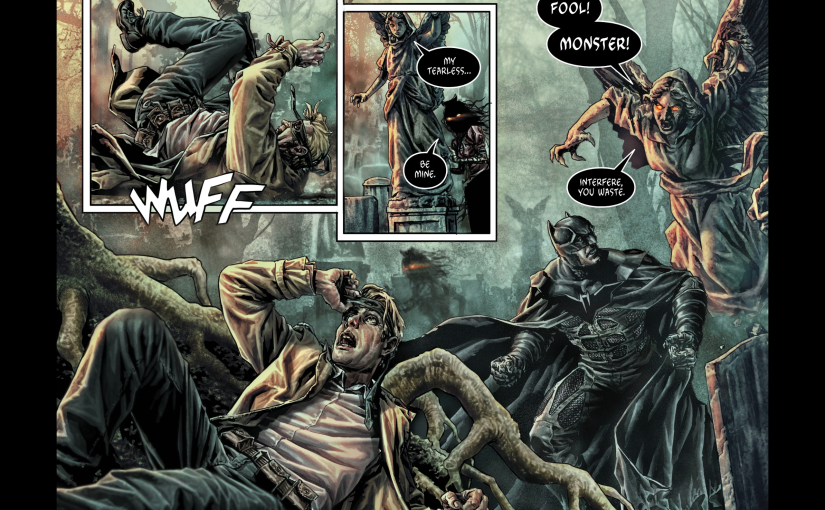
Brian Azzarello’s and Lee Bermejo’s disorienting run together on Batman: Damned can be interpreted in many different ways, and I think that’s partly the point. I won’t be the authority on this story. I think the closest person to come to that — other than Azzarello himself — is Rich Johnston in his recent review, which connects the Damned to Alan Moore’s Killing Joke and Azzarello’s Joker from nearly a decade ago. Instead, I’ll share my interpretation, which is one I didn’t find elsewhere in the other reviews I read.
I’ll skip over the controversy of Bat Wang, the complaints about Azzarello’s relentless punning, the bitching about how flat the blood looks, and get right to the point of my review. I think that superhero comics, at their best, are always a mythology story. Batman: Damned is a mythological story about a man confronting fear, lack of control, judgment, childhood trauma, and desire. It features infidelity, weeping, attempted rape (a more sensible version than the attempted rape in Miller’s Superman: Year One), empathy, confusion, and all the other emotions that make being human so damn exhausting.
I reread the all three books of Batman: Damned in one day, and still struggled to be confident in my interpretation — until the start of my fourth go-around when I realized that the narrator implies that the hero is in hell, and that his quest is more about finding himself than finding out if the Joker is truly dead: “Literally bloody hell. I say that, havin’ a knowledge of it. An’ the depths we’ll go to ESCAPE it.” (If you’re curious about the heavy-handed Britishness of the quote, it’s because narrator is Constantine, who’s more a vehicle for Azzarello’s voice and style than anything else. That’s all I have to say about that.)
Once I accepted that Batman is in hell, and that the myriad of supernatural DC characters were there just to add to the story, the entire plot that follows from that moment in issue one onward became much more straightforward. The laws of storytelling become more flexible, leaving Azzarello and Bermejo plenty of room to craft creative transitions and moments of poetry.
The “Batman is actually dead this whole time” interpretation explains all the abrupt transitions in setting from hotel to cathedral to underground rap concert to graveyard to magic club. It means that the moment Batman falls from the bridge (which is what we’re misled to think actually happened) is really his descent into hell and the beginning of his judgment. It means Batman died on top of trash bags in the street after the Joker stabbed him, and he’s touring hell awaiting the judgment that finally comes in issue 3. Once he’s in the G.C.P.D. morgue, Batman fittingly decides his own fate, finally surrendering himself to death.
This storytelling technique isn’t what makes the books of Damned mythology or even part of the comics canon. It’s Batman’s true foe in the story: not the Joker, but Desire and Fear of Desire, the character otherwise known as Enchantress. She is a demon who strikes a deal with young Bruce: “no tears for fears.” This serves as Batman’s origin story. She torments him his whole life — from childhood to manhood — like death trying to claim him, to get him to surrender. Her presence is associated with Thomas Wayne’s infidelity to his wife Martha, and Bruce’s discovery of how this torments his mother. Even when Batman “defeats” Enchantress, she ultimately wins in the end. No matter how strong the hero, no matter how much money he has, no matter how long his wang is, he will always have to surrender to death.
Speaking of heroes, Lee Bermejo’s art is a herculean achievement. I place him in the elite rank of Alex Ross, and would even dare to say that I prefer Bermejo’s renditions of the human form, cityscapes, facial expressions, action sequences, and landscapes to those of Ross. I was especially impressed by the way he conveyed the aftershock when Harley Quinn’s bombs went off in Gotham, and how he illustrated the confusion Batman experienced while drugged. He made this story horrific.
It’s a real shame that people didn’t have more patience for Damned, and it’s an even bigger shame that the executives at DC cowered from the clear momentum that this book had.
The comics world is experiencing an onslaught of horror books. DCEASED and THE BATMAN WHO LAUGHS are just some of the popular titles satisfying and inspiring a bloodlust in comics fans, who are highly-anticipating ABSOLUTE CARNAGE on the horizon. Recently, Bradley Golden has unleashed some bloodshed of his own. His new series, HORROR COMICS, debuted on May 29, sparking a lot of conversation among fans of violence and gore. His upcoming series, LEAVE ON THE LIGHT, keeps the horror craze alive…with a lot of death.
What’s LEAVE ON THE LIGHT #1 about?
“In a small town near New York, an undead serial killer has begun claiming the lives of children using the city’s electrical system.” This is the pitch sold to backers of Bradley Golden’s Kickstarter for LEAVE ON THE LIGHT, a supernatural horror comic published by Antarctic Press and the author-owned Second Sight Studios. This three-issue, 24-page horror mini series was supposed to debut on June 26, according to a recent interview with economics in comics, where Golden discussed his forthcoming series. According to a recent tweet from Golden, however, the launch date has been delayed until July 10.
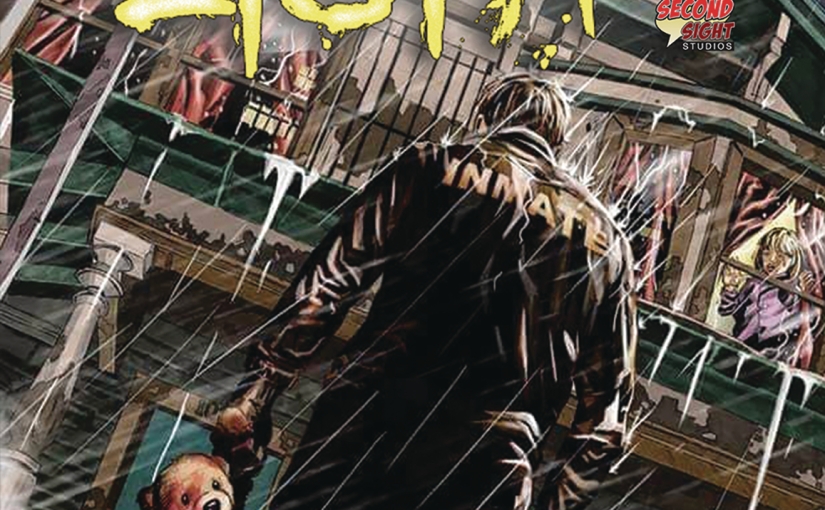
Set in suburban New York, LEAVE ON THE LIGHT begins with the sudden, brutal murder of a little girl, Kassey, and her mother, Claire, the night before what would have been her daughter’s first day at a new daycare. The murderer is an escaped inmate wearing a prison uniform. He has gaping lesions on his face, electric currents pulsating from his body, and a heavy stream of drool oozing from his snarled mouth.
As police pore over the crime scene that night, we meet Detective Gary Marshall, assigned to look into the murder of the Maxeys. After some broody inspection and chain smoking, he thinks the dismembered bodies and crime scene look identical to those of Thomas Butcher Lassey, a child killer who was sentenced to death by electric current eight months ago.
Troubled by the resemblance of this crime scene to others, Detective Marshall and his partner, Sarah McKinney, begin their investigation. One of their lives is in danger by the end of book one.
The Writing
Generally, the story is intriguing, but the writing and art need more attention to detail.
Using well-timed moments of restraint, Golden makes you ask questions about multiple elements of the story to build demand for the next book. I found myself curious about characters’ pasts, and wondered if what I was seeing in the panels was real. To refrain from any spoilers, I’ll say that the killer is likely supernatural. It’s clear that Golden has an interesting plan for this tale of depravity and revenge.
Sometimes, the storytelling was interrupted by stiff dialogue in scenes where characters are alone. In one bit of dialogue, Detective McKinney talks about how she’s going to put down some toilet paper on the seat because the gas station bathroom is dirty. I think the author felt like he has to fill the silence in these necessary moments and convey something to the reader.
Bradley Golden is credited as the writer and editor of LEAVE ON THE LIGHT, and it shows. There were a few mistakes in the copy that I’m sure will be resolved by the launch date. (He does tell me, however, that he’s working with an editor before this book releases — and that he welcomes suggestions from fans.)
The Art
There are really well-drawn cars in this comic. There’s also expressive faces and moody color palettes. Props to penciler Alex Sarabia, inker Lehkem Amiyr, and colorist Shannon Smith. Letterer Hector Negrete adds to the composition with his evocative sound effects. Be on the lookout for a funny cameo they create together in a couple of panels toward the end of issue #1!
Some visual elements were confusing. For example, heavy speed lines made backgrounds less detailed, and they seemed to occur faster than the pace of the actual action. In my first reading, I thought the “VZZ” and “FZZ” lettering effects were cell phone vibrations when they were actually bursts of electric current that power the killer Thomas Lassey.
There were also some inconsistencies in the art. In one scene, the killer has large lesions on his face. In his second appearance, his skin is unblemished. (Perhaps this shows he’s getting more powerful and gaining strength? It wouldn’t be outside the realm of the supernatural. Still, it took me out of the moment.)
Rating
6.5/10
Kickstarter comics like Icarus and the Sun have been getting a lot of buzz lately. So has horror. Those two trends meet in LEAVE ON THE LIGHT from Antarctic Press.
Feels like a classic horror story with supernatural elements. Reminiscent of A Nightmare on Elm Street and Poltergeist.
The art and writing are limited in depth.
Because of good pacing, there’s lots of room for the story to developed.




















 Secret Society Comics