Superman: Year One is the Comic that Nobody Needed, Especially in 2019

If you’re going to judge a book by its cover, then comic books are perfect for that. The covers for Superman: Year One #1 are pretty uninspiring. So is the book itself. But it’s more than uninspiring. It’s cruel.

Frank Miller and John Romita Jr. team up for a modern-day retelling of Superman’s origins — except there’s nothing modern about it. Let’s get the stale plot out of the way so that we can talk about the stagnant idea behind it, the cancerous stereotypes, and the dusty tropes.

Krypton blows up. In a rocket made by his father, Kal catapults through the galaxy. He crashes into earth, where he meets his parochial parents and becomes Clark Kent. Immersed in Miller’s version of Americana, Clark grows up, fights off some bullies, saves his crush from a gang-rape (more on this disastrous scene in a bit), plays some football, gets laid, and then enlists in the Navy.

Father-son “wisdom” at the expense of women everywhere. Classic!

As you can see, the plot isn’t innovative or remarkable. But it does make you see Superman in a new light. That light isn’t flattering.

Clark doesn’t have any interiority here. If he does, all we get is his sense of superiority and frustration. Sure, Clark’s a teenager, but his thoughts reek of Miller’s own prejudices and teenage hangups — from sexist comments, creepy innuendos, obnoxious bravado, to stubbornness that’s nothing more than stupid.

Before the bullies escalate their crimes against innocent podunk Kansas to rape, they’re doing the classic bully stuff that has been portrayed in American film and TV for decades. Amid this yawn-inducing buildup, Clark says, “This is madness. Madness. Why?” It’s because they’re bullies, Clark. This is as deep as Clark Kent gets in Miller’s hellscape.

The bullies achieve obligatory villain status when they attempt to gang-rape Clark’s crush, Lana. She’s on the dirt, crying, with some hands holding her down, others touching her where she’s vulnerable. Clark saves her before the violence escalates, commenting on how feeble human beings are all the while. He then whisks Lana up into the clouds before dropping her at home and asking “Let me court you, Lana Lang” with no regard for what she just endured, no curiosity, no compassion, no sorrow, no anger. It’s incel savior mentality at its worst.

Clearly, the intent and ideas behind Miller’s writing are lacking. So is his style. The voice of the narrator drunkenly wobbles between Miller and Clark Kent. There’s a matronly-looking teacher who says “dumplings,” “my blossoms,” and “angels” within four fucking panels. There’s establishing narrative captions, like “Back home. Supper time” that are entirely pointless because we can see that Clark is indeed at home eating food.

The worst and most prominent lack of style is the unnecessarily bolded font. In the very next panel after the rape scene, here’s what Frank Miller has to offer the people who paid eight dollars to read this: “Boning up there, Mr. Kent?” (Lana) “Damn if Lana doesn’t just have a way of saying things…” (Clark). Excuse me while I go hibernate in a nuclear winter.

An unoriginal sex pun. Nice!

Comics are collaborative, so Miller can’t fully bear the weight of this book’s crushing failure — with the exception of letterer John Workman and colorist Alex Sinclair. Workman excels at making Miller’s gratuitous dialogue highly legible, neat, and crisp. Alex Sinclair imbues finer textures, like prairie grass and hair, with colors that feel natural and bright. John Romita Jr. may have sprung from the loins of a legend, but apparently it takes more than that to draw children’s heads proportionally. Many times, Clark Kent looked like a bobblehead. Danny Miki’s crosshatching is too clumsy and spaced out, while his line weight is unbearably light and heavy. Then again, no inker could salvage Romita Jr.’s creepy take on the human form.

The first installment of this new Superman series was the perfect opportunity for Miller to explore Clark Kent’s boyish charm in a complex, characteristically dark way for the author. Instead, we all can see how immature Frank Miller really is. There’s nothing charming about it. While this Black Label retelling of Superman’s origin is supposed to deviate from the world’s first superhero who we know and love, it’s nothing more than a perversion.

Rating 3/10
Review of SILVER SURFER: BLACK from Donny Cates and Marvel Comics

Silver Surfer: Black is a passion project for Donny Cates, and it shows. It’s the culmination of boyhood dreams, professional ambition, meticulous plotting, expansive imagination, and hours spent writing, refining, writing again.

Issue one of Silver Surfer: Black is a cosmic blend of Donny Cates’s soul and Marvel corporate. Each an invincible force gleaming with incomprehensible power like the Surfer himself.

In order to write something this plotted, you have to really love comics. I’m not sure enough people know that Editorial at Marvel really does love comics. Sure, their names are credited in the issue, but…

Since Marvel’s Editorial team so relentlessly and effortlessly interweaves story arcs, characters, and universes, I’ll leave it to them to catch you up on the cosmos before we get into Silver Surfer: Black.

To save his planet, Norrin Radd surrendered his freedom to become herald to the world-devouring Galactus. Coated with galactic glaze, given a surfboard obeying his mental commands and granted the power cosmic, he now soars the universe as a shining sentinel of the spaceways! The galaxy was in chaos after Thanos, the mad titan, was killed. The cosmos’ greatest warriors gathered to hear the reading of his last will and testament — only to be attacked by Thanos’ Black Order! In the ensuing battle, the Black Order opened a black hole and cast several heroes — including the Silver Surfer — into the abyss. Now, drowning and unmoored in an endless void, the surfer is lost…

Silver Surfer Black, issue one preface

Reading experience

For us, Silver Surfer: Black is a comics zeitgeist moment. A tribute to the past and beginnings of the Marvel Universe, publisher in a time when the future of comics never seemed so bright, from self-published webcomics to global movie domination. This comic is a spectacle worthy of the infinite variant covers it has spawned. It’s the most poetic and vulnerable comic I’ve ever read.

For Marvel, it’s a boon. A comic that can increase their dominant market share just a bit more, get readers to buy into new universes. To fully understand this departure from reality in your hands, I’d say you need to know your Guardians of the Galaxy — and Donny Cates’ entire magnum opus. (I took Marvel Editorial up on their advice and acquainted myself with Guardians of the Galaxy — Annual #1 and Guardians of the Galaxy #1, both released in 2019.)

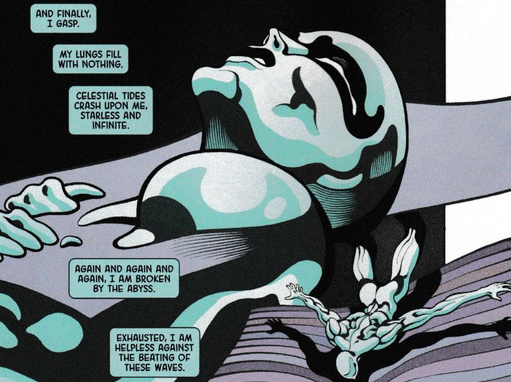
Cates’s writing is poetic and ambitious. (My favorite line: “Celestial tides crash upon me, starless and infinite.” My favorite words: “felled,” “cull,” “unmoored,” “bedlam.”) The story reads as if it is fresh off the lips of an omniscient being shouldering the trauma of millions, rather than a guy in Austin, Texas.

The framing of the story is equally poetic. Cates’s Silver Surfer begins by saying he is known as Death, and ends by affirming “I am not death. I am a blazing light in the abyss — and though drowning in the shadows — overwhelmed and suffocated by the dark —I ignite. I shine.”

How’s the art in SILVER SURFER BLACK?

There is, of course, another poetic element to this story. The dynamism between the words and art shows just how far back Cates and Tradd Moore go, from former classmates at Savannah College of Art and Design to the top of the most world-renowned comic book company.

The history here — between Cates and Moore, Cates and Stan Lee, and Lee and Kirby’s surfer plus the Surfer of 2000s movies & modern angst — is something to behold. And it is a visual spectacle to behold, indeed — with a texture, weight, arrangement, and palate unlike anything else currently published.

The fluid expressions of Moore’s lines, Stewart’s colors, and Cowles’s letters are perfect for this epic. It’s hard to imagine the fabric of reality tearing apart into something timeless and infinite, but these guys can.

My favorite visual moments:

  • Silver Surfer crying as he relives the worst period of his life. The tear fades into a speed trail.
  • The black hole pages have psychedelic borders made of earthy tones. If there were a shirt with these patterns on it, I’d buy.
  • The physical and atmospheric deformities caused by the torrent of motion and time in the black hole.
  • The revelation of the Surfer’s black, iridescent hand is absolutely iconic.

Contains Spoilers: What happens in SILVER SURFER BLACK issue one?

Norrin Radd — the Silver Surfer, Sentinel of the Spaceways, the Herald of Galactus unchained — goes by many names, including death. Throughout, he grapples with his complicity in decimating people and planets by Galactus’s side. He feels remorse over his “cold stare” and “stone inaction.” He sheds a silver tear.

After this recap, we see Norrin fall into an endless wormhole with the other Guardians of the Galaxy. He implores Beta Ray Bill to summon Stormbreaker and create a chasm black hole. (If you don’t take my word for it, then consult an interdimensional galactic physicist or Donny Cates.) After this disruption, the Silver Surfer tears through the abyss, his speed and power cosmic eventually breaching the fabric long enough for his fellow heroes to escape.

After they are safe, he collapses. Saving pantheons of heroes absolves his guilt only partially. Now he must ponder his guilt indefinitely as he careens through something beyond spacetime. He floats and falls for years, hurting, healing.

Suddenly, he senses that there is a planet eons away where evil forces are killing the innocent. He answers the call and is confronted with three giant sentries guarding some phallic metal thing. They engage in a battle, against the Surfer’s wishes and pleas for help.

Instead of killing the sentries, he restores light to this dark, barren world. The hand he used to birth that infant star becomes black and iridescent.

Is the black hole part of him now? It seems so. It seems the blackness might consume him.

The sentries are revealed to be “goddesses of some abandoned pantheon.” They must have been under some spell, because their faces are revealed when they were concealed before, and their faces are beautiful.

He investigates the mysterious metal structure, now opened. In a Marvel-Cates checkmate moment, Knull awaits the Surfer inside. (It is implied that the Surfer was catapulted to the beginning of time, and now he stands before the father of Symbiotes, Knull.)

9/10 Rating

Review of CATEGORY ZERO #1 from Scout Comics

Scout Comics has been on a winning streak lately. With their series THE MALL being optioned for TV, and April’s premier of ELECTRIC BLACK generating buzz among readers and speculators, Scout has established itself as a powerhouse among indie publishers.

This week, Scout debuts a promising new series, CATEGORY ZERO, written by Adam Kiamil, with art by Ton Lima, and colors by Derek Dow. According to Kiamil, the creator, the target audience for this series is those “who grew up reading comics like X-MEN and HARBINGER, but whose tastes have moved away from the traditional superhero genre.”

What’s CATEGORY ZERO about?

Earth’s entire population is infected with the Strix virus. First discovered by scientists at Sanaxus research 20 years ago, the virus and its symptoms manifest in one percent of the population. At the onset of the virus, these “One Percenters” experience flu-like symptoms before abruptly developing superhuman abilities — either physical or mental.

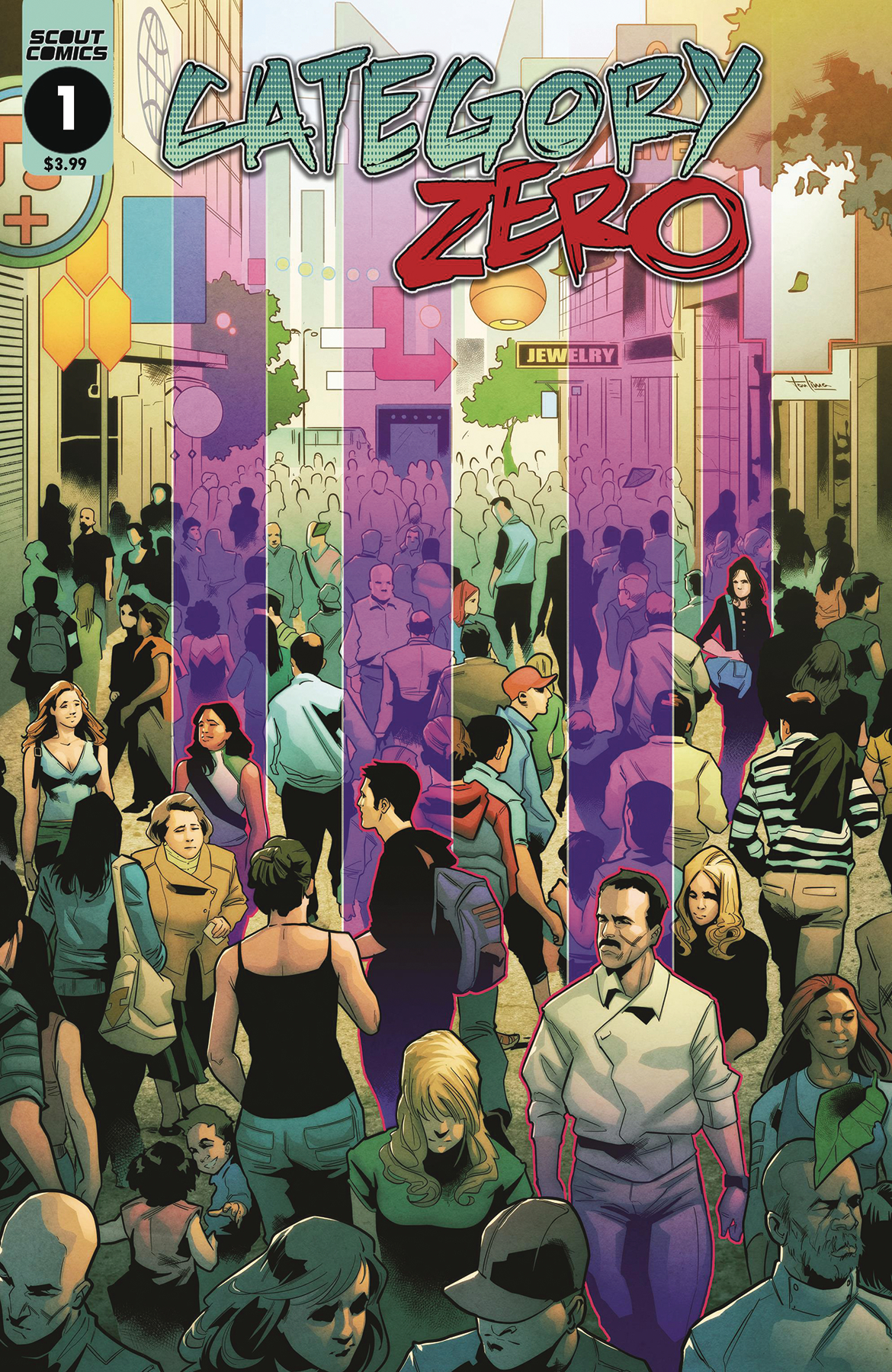
The clever cover of CATEGORY ZERO #1.

In most cases, these powers are harmless, but sometimes, One Percenters pose a threat to the general populace. To treat and study the virus, Sanaxus has developed secure research facilities where known One Percenters live together in suburban-looking communities. As always in the suburbs, things aren’t what they seem.

What’s issue one of CATEGORY ZERO about?

In the opening pages of CATEGORY ZERO, we travel back in time 20 years to meet Phillip Patterson, one of the original Strix researchers at Sanaxus. He has recently been promoted, but suddenly dies at the congratulatory surprise party celebrating his achievement.

Phillip Patterson in his final moments.

With his dying breath, Phillip confesses to his son, Jake (also a Sanaxus researcher), that “Strix isn’t what they say it is.” When Phillip says “they,” I assume he’s referring to Sanaxus, and that whatever they’re lying about will be the engine for the plot in CATEGORY ZERO.

In the present day, Professor Sarah Higgs delivers a lecture on the Strix virus to college students — a seamless way for Kiamil to provide context. One of her students, Neve (who will likely take on a larger role in the series following issue one) asks about her husband and his former professor, Leonard Higgs, a One Percenter receiving treatment at Eden, a Sanaxus facility.

After Sarah and her daughter visit Leonard at Eden, they stop by Arrowbank. While waiting in line, they encounter an ill-looking man coughing uncontrollably. His flu-like symptoms escalate until his hand tremors. Suddenly, the entire building is shaking as if there were an earthquake. Arrowbank collapses, presumably killing everyone inside.

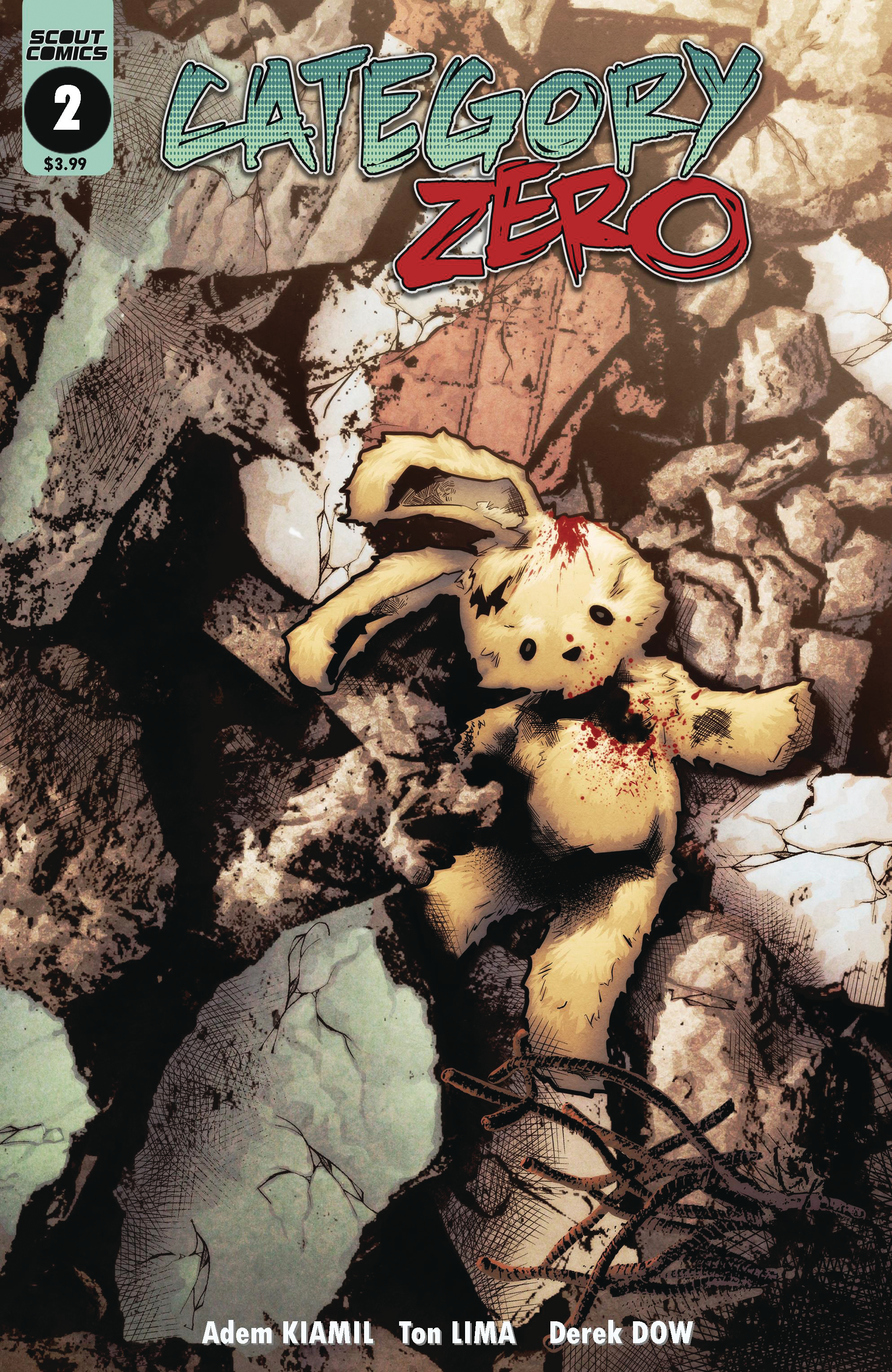
The cover for CATEGORY ZERO #2 is similar to the final panel in issue one.

How’s the reading experience?

In 2019, Americans are, more than ever, considering the experience of marginalized “others” — those who are always disadvantaged, sometimes poor, and generally not part of mainstream society. As such, One Percenters are segregated into isolated communities, further away from the rest of the population who struggle to understand them.

In this way, THE BEAUTY and X-MEN are taken up in CATEGORY ZERO; themes like social exclusion, mutation, viruses, and intervention by governments and corporations are at the forefront. All of this makes the story an ambitious undertaking. Unfortunately, that ambition doesn’t come through in the execution, which feels mostly flat.

The plotting and world-building are the strongest features of this series debut. I liked the multiple timelines in issue one of CATEGORY ZERO, and am curious to see how the past shapes the events I’ll witness as I continue to read .

Released covers for CATEGORY ZERO #3 suggest that Sanaxus has a hidden agenda for the Strix virus and the affected One Percenters.

At the dialogue level, however, the writing was sometimes corny — particularly in the scene where Sarah, Leonard, and their daughter reunite. As a relentless grammarian, I noticed that there were minor blemishes in punctuation and sentence structure; when comics don’t have an editor credited, this is often the case.

Art in CATEGORY ZERO

Generally, the art was impressive and unique. The triangular facial structure of the characters reminds me characters in SUPERIOR SPIDER-MAN by artist Mike Hawthorne. There were impressive backgrounds in larger panels, where the chunky lines gave the art satisfying weight and texture. The color pallet had a muted, sickly green color, which felt entirely appropriate. Overall, though, the art could be more detailed.

Should you invest in the CATEGORY ZERO series?

CATEGORY ZERO is a consistently-paced, somewhat satisfying read sandwiched by two cliffhangers at the beginning and end. I am slightly curious to see where the creators take this series. If the series benefits from more focus, editing, and plotting, I can easily imagine TV and film producers throwing money at the concept.

Rating

6.5 / 10

  • Solid storytelling
  • Timely themes
  • Immersive intrigue
  • Lack of attention to detail

Review of SHE SAID DESTROY #1 from Vault Comics

What’s SHE SAID DESTROY issue one about?

Good versus evil is a classic comics trope. That formula gets a lot more interesting when traditionally evil forces are on the same side as the good guys. Enter the Goddess of death and queen of fairies, The Morrigan.

She is one of the two remaining Gods from her pantheon, who were forgotten and erased. Her only remaining sister, Brigid (Goddess of the Sun) has persuaded the entire solar system into devoutly following her, using the force of inspiration. The Morrigan and her people, who reside in the colony of Fey, are the last obstacle in her quest for domination.

The Sun Goddess, Brigid, about her flagship, The Inspiration.
The Sun Goddess, Brigid, aboard her flagship, The Inspiration.

The only thing stopping Brigid from conquering The Morrigan and converting her followers are Jackelyn (a galactic witch), Winona (the princess of Fey), and her best friend, Raul.

How’s the reading experience?

On the first page, author Joe Corallo implies that because “some gods wanted more,” “cultures were homogenized and erased.” No details of this backstory come through in the issue, but it affirms that Brigid is the antagonist; in her crusade to get every person to conform to her worldview, Brigid has effectively erased the many cultures of the solar system.

Page one of SHE SAID DESTROY introduces the reader to the history of this fantasy universe.

It’s clear the Brigid is motivated by the fate of the other gods: she fears being forgotten as they were. This premise is not entirely unique, and I did not feel an attachment to Brigid and The Morrigan. Their characterization, motivation, and relationship to each other rung hollow.

The apparent protagonist of the series, Winona exudes strong Jon Snow vibes — noble, skilled, and persistent, but somewhat uncomfortable in the spotlight. Much like Brigid and The Morrigan, unfortunately, Winona’s personality is one-dimensional. She is kind to everyone, a good friend, and appreciative of life, but neither Corallo, Kangas (artist), nor Nalty (colorist) indicated that she has endured trauma, or is capable of being anything but good.

Introduction of Winona, and her friend, Raul, who is jealous of her power and prominence in Fey.

This story has the pieces of a successful comics saga: space opera genre, with fantasy and sci-fi elements, conflicting belief systems about to be at war, and an inclusive cast of characters and creators. But did these pieces come together? Not in my opinion.

How’s the art in SHE SAID DESTROY?

Generally, the art in this debut issue parallels the quality of the storytelling: many flat colors, line-work that feels hasty and incomplete, and attempts to convey motion that feel static nonetheless. Often, I couldn’t clearly discern what I was viewing. Even if this visual disruption was intentional, it evoked no emotional response in me.

I will credit Kangas and Nalty with the ability to create imaginative worlds, expressive costumes, and memorable faces with even more distinct facial expressions — this, especially, is rare. All these strengths were apparent in the differences in Brigid and The Morrigan. Exuding a magical aura, the Sun Goddess was regal, enshrined in gold, ephemeral, and evidently at the peak of her power. On the other hand, Brigid, whose powers are waning, had a relaxed posture, more woodsy garb, and several fairies floating around her.

The Saga homage variant of SHE SAID DESTROY issue one.

Should you invest in this series?

After the first reading, I felt profoundly unmoved. After the second round, I felt more appreciation for the narrative structure, characters, and message — but still unmoved.

There is a distinct lack of pacing and world-building that manifests in the hurried art. I most likely will not continue reading SHE SAID DESTROY #1, but respect the intentions of its creators.

Rating 6.5 / 10


Review of QUEEN OF BAD DREAMS #1 from Vault Comics

8.5 / 10 Rating

MADAME XANADU Homage Variant, Michael Kulata

What’s QUEEN OF BAD DREAMS about?

Set far enough into the future where flying cars are no big deal, QUEEN OF BAD DREAMS is about a woman who decides the fate of dream entities (called figments) who’ve “dropped” into the real world.

The hero of the story, Daher Wei, is the model employee at the Morphean Annex, the organization that handles all issues related to figments. As an Inspector Judge, she decides if the figments are reinserted into dreams, given residency in the waking world, or are neutralized.

Inspector Judge Daher Wei on the job.

Don’t sleep on QUEEN OF BAD DREAMS #1

In issue one, a particularly powerful figment named Ava escapes from the imagination of a man named Emerson Chase. He’s the son of an influential councilwoman, whose family has a complicated relationship with the Morphean Annex. For years, Ava’s protected him from nightmares, but she seems to have new priorities. Judge Wei’s job is to determine if Ava has enough agency to be granted a life beyond the confines of Chase’s mind.

Chase’s dream figment, Ava, has escaped into the world.

In issue two of QUEEN OF BAD DREAMS, we’ll likely learn more about Ava, why she escaped, and how Emerson Chase is one of those “Men who fall apart when you challenge their worldview,” according to the narrator, Daher’s ex-wife, Viv. The purpose of Ava’s character, it seems, is to say that certain figments have the same humanity as people — or even more. The QoBD series will be five issues long.

My opinion

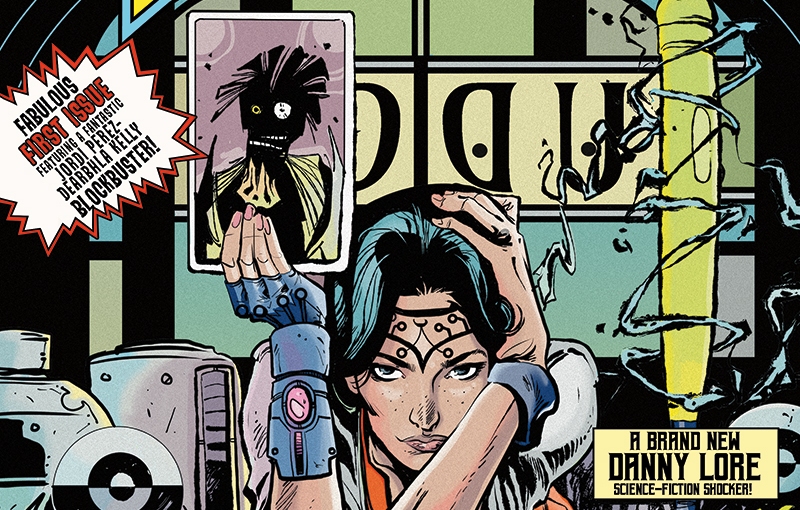
Jordi Pérez (inks) and Dearbhla Kelly (colors) work together to create trippy, dreamlike art with a wobbly fisheye-lens quality.

Written by Danny Lore, the plot and relationships between characters are brimming with possibility. As a queer woman, I’m especially interested to learn more about Daher and Viv’s former marriage beyond the work-life balance issues. For such a unfamiliar world, the writing about it was clear. There was one scene, however, between Daher and her partner, West, that was tough to follow.

I’m looking forward to issue #2, releasing next week on May 29.

Queen of Bad Dreams Issue #2 cover

Review of 4 KIDS WALK INTO A BANK Chapter 1 by Black Mask Studios

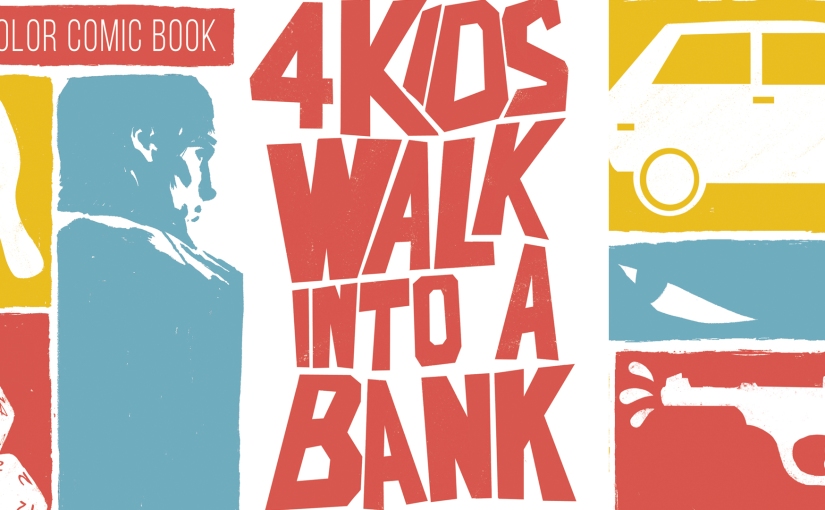
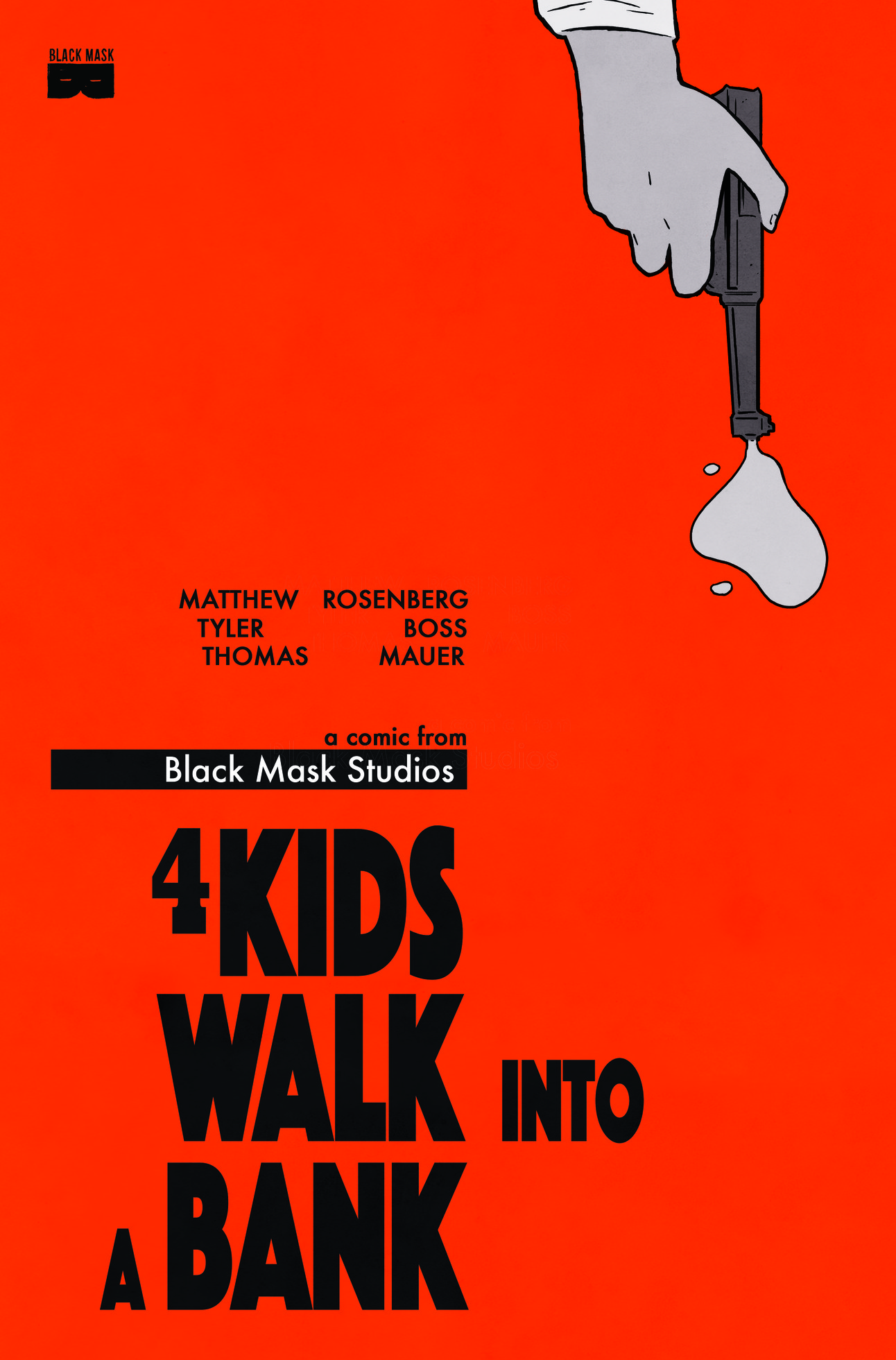
4 KIDS WALK INTO A BANK Stray Dog red homage cover

9.5/10 Rating

What’s 4 KIDS WALK INTO A BANK about?

The title, 4 KIDS WALK INTO A BANK, makes the series sound like the start of a convoluted dad joke. In actuality, 4KWIB is a well wrought crime / humor story written by Matthew Rosenberg (of UNCANNY X-MEN) about kids, the awkward middle-school years, friendship, family, and the bank heist of a lifetime. First published in 2016, Chapter 1 is part of the five issue mini-series, which has recently been optioned for the movies — and with good reason.

Why is this comic worth your time?

The first installment of this gloriously quirky 1980s caper has all the ingredients for a successful big screen adaptation that will remind readers of Stranger Things and Wes Anderson flicks.

In the first pages of Chapter 1, the four kids are playing Dungeons & Dragons in an ephemeral action sequence masterfully illustrated by Tyler Boss. By the end of the issue, they’re grounded in a strange reality where they’re spying on a bunch of ex-cons who saved them from some schoolyard jocks…and also just barged into one of their homes.

Rosenberg and letterer Thomas Mauer imbue each kid with a comically distinct personality, making me feel like I knew all the inside jokes and was part of the group. This doesn’t happen a lot. I just finished Y: THE LAST MAN — 11 years late, I know — and as emotionally attached as I was to Yorick’s journey, I felt like the dialogue for every character had the same wit and sarcasm, which was really just the voice of author Brian K Vaughan. Rosenberg’s writing doesn’t suffer from that monotony.

By the end of Chapter 1 of 4KWIB, you’ll have enjoyed some quality laughs, be in complete admiration of Paige (the group leader / badass wonder child), and need to know what the hell is going on with her dad and these unruly ex-cons. You’ll want to read Chapter 2 ASAP.