Everything You Need to Know about House of X #1

Geopolitics, genocide, drugs, religion, corporate entities, Magneto — House of X #1 has it all. This is the kind of story that requires you to pay attention.

That one promo image for HOUSE OF X that you’ve seen 5,000 times.

The Most Important Things from HOUSE OF X #1

Humans of the planet Earth. While you slept, the world changed.

Professor X, epigraph

What is Krakoa?

Krakoa is Charles Xavier’s perfect mutant habitat, a garden of Eden with no snake, no fruit of knowledge, no Eve, no Adam — and especially no God. The island is the seat of the sovereign mutant nation-state established two months ago.

Cyclops says that “New beginnings demand a wide berth.” In the opening pages, we see X-Men planting flowers around the world over a five month period. They’re planting roots in the natural world to grow the infrastructure of their sovereign mutant nation.

Only mutants can access Krakoa. Advantageous gateways allow mutants to travel all around the world via the Krakoan ecosystem, but only mutants can access those portals. If humans are present, the gateway grants or denies permission for them to enter — but only if a mutant asks on the human’s behalf.

Make no mistake: Charles Xavier is creating a distinct culture, with its own language, land, economy, environment, and drugs.

The Flowers of Krakoa

This chapter title refers to the flowers/drugs that allow mutants to access different environments and states of consciousness unavailable to humans.

We learn that Xavier acquired a pharmaceutical company to produce pills that enhance the immune system, lifespan, and mental health of humans exclusively.

This sets up an interesting contrast between humans and mutants. Mutants: natural (flowers), community-centered. Humans: synthetic (pills), self-centered.

Krakoa Pacific

The introductory pages provide a geography of Krakoa, with indicators to 12 key locations.

According to Dr. Gregor, who is a pretty foundational character in the series, humans only have 20 years left before extinction.

Pan to outer space, where we see The Forge — a space station shaped like a giant Sentinel head. This outpost will help humanity “survive the coming days” in accordance with the Orchis Protocol (explained below).

Orchis Protocol: Build for Doomsday

This protocol is a response to a unique scenario when human population is threatened with extinction, the moment when natural selection finally chooses mutantkind over mankind.

The word “Orchis” is derived from Greek for “testicle.”

Three triggers cause this doomsday scenario, and they’re distinctly political:

  1. Population: mutant gene rates are escalating
  2. Financial: Charles Xavier acquired the seventh-largest pharmaceutical company in the world to make cure-all pills, a move predicted to destabilize the industry and provide him a unique advantage
  3. Territorial: the nation of Krakoa is established

After this context, we see mutants obtain a copy of the combined database from 2 smartest people in the world. They are confronted with the Fantastic Four upon their escape. The contents of the data are unknown, and it makes a solid cliffhanger.

Damage Control

There is a corporate entity weaponizing Iron Man’s and Mister Fantastic’s technology. They add this ownerless intellectual property to an archive of similar assets where there is no clear chain of custody over that intellectual property.

Scott Summers/Cyclops tries to diffuse the situation with the Fantastic Four. using it as an opportunity to state Xavier’s politics. This moment draws an interesting and deliberate line between Marvel’s heroes and their ideologies.

Omega Level

The book ends by suggesting Magneto finally has his chance to be a god.

HOUSE OF X variant covers

Omega Level mutants are an elite class of the world’s most powerful mutants, of whom the Krakoan state is especially protective. Magneto is one of these rare beings.

Charles Xavier has made you an offer — one full of grace and brotherly love — but one that is also written in stone. This is not a negotiation. Things will be different now, and the sooner you realize the finality of your situation — and the inevitability of ours — the sooner you will be grateful for the things we are so generously giving to you.

Magneto

Mutants are the new gods, so it’s fitting that the ever-dramatic Magneto needed to make this statement in Jerusalem, the birthplace of the three Abrahamic religions: Islam, Christianity, and Judaism.

Time is a Flat Circle

The book, after starting with a quote from Charles Xavier, ends with a Magneto quote.

I have a new word for the lexicon of man: KRAKOA. And in the future, when you speak it, make sure you do so softly and with proper deference. For we will be listening.

Magneto

This speaks to the unity of mutants, and also makes the reader question just how aligned Xavier and Magneto really are. Would Xavier threaten humanity this blatantly? Is he already doing that?

HOUSE OF X & POWERS OF X Reading Order

“Two Series That Are One.”

House of X #1July 24, 2019
Powers of X #1July 31, 2019
House of X #2August 7, 2019
Powers of X #2August 14, 2019
Powers of X #3August 21, 2019
House of X #3August 28, 2019
House of X #4September 4, 2019
Powers of X #4September 11, 2019
House of X #5September 18, 2019
Powers of X #5September 25, 2019
House of X #6October 2, 2019
Powers of X #6October 9, 2019

Rating 9.5/10

  • Jonathan Hickman writes a unique premise that engages a lot of contemporary social and political issues.
  • Incredible graphic design from Tom Muller.
  • Bright and luscious colors from Marte Gracia softened the heaviness of Pepe Larraz’s lines, creating art that is on par for Marvel.
Review: Superman’s Pal Jimmy Olsen #1

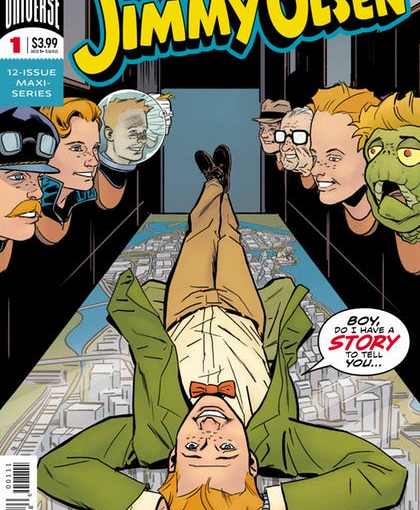
Who would’ve thought that a Golden Age character would become the poster-boy for “pivot to video”? Well, in Matt Fraction and Steve Lieber’s newest maxi-series, anything’s possible. Superman’s Pal Jimmy Olsen #1 is a hilarious collection of four related short stories provide a “bizarre tour of the underbelly of the DC Universe.”

The series opens with a family history of the Luthor and Olsen families, focusing on their role in shaping Metropolis. In a hilarious death sequence, Jimmy’s “great-great-grand-something” falls to his death after getting whacked with a shovel while disputing over the land that would be Metropolis. After this brief history, we see a standard day in the life for Jimmy Olsen: falling from outer space with nothing to break his fall…while metamorphosing into a giant turtle, thanks to a biomedical experiment. Though Superman tries to save his life and prevent major damage to Metropolis, he shatters The Monarch of Metropolis — a massive lion monument/tourist attraction erected by the Luthor family.

These shenanigans are fun, but the story really hits its stride in the second half. Jimmy’s space turtle fiasco costs the city and the Daily Planet, but the video of his fall is the only thing bringing money in for the publication. He’s too much of a liability for Metropolis, but he’s good for business, so Daily Planet’s publisher relocates him to Gotham. After moving in to his crappy new digs, it’s revealed that the Daily Planet published a front-page fake news story about Jimmy Olsen getting murdered!

For me, this was a comical story about the “long, slow death spiral” of print media, as the comic puts it. The “pivot to video” and clickbait trends are central themes to this story filled with wacky plot points. Fraction uses puns, witty wordplay, and slick sarcasm in a measured way that complements the strange subject matter. Steve Lieber’s art is just cartoony enough to match the funny script, and the colors heighten the Golden Age nostalgia while remaining crisp.

Credit: DC Comics

Rating 9/10

I need to learn more about the DC Universe, and this comic seems like an amusing tour de force. As a writer, I’m delighted to see comic creators working in a print-based medium address the challenges of the twentieth century. Although comics have adapted to the digital medium (with Comixology), the silver screen (MCU movies), and smaller screens (YouTube reviewers), it’s nice to see a traditionally print-based medium address its own reckoning in such a lighthearted way.

Invisible Woman #1 Review: Has Potential to Be about Infidelity, But Probably Won’t Be

Susan Storm is one bored MILF.

I assume that bored moms let their minds wander to the past, a time when they were less bored. If a bored mom is unemployed now, she might think about former career highlights. If her children are young, and if there are a lot of them, she might fantasize about the days when all she had to worry about was herself. If she’s unhappy in their marriage, she might think about more emotionally and sexually attentive boyfriends and lovers from the past.

From what I can see in issue #1 of Invisible Woman, Susan Storm is a bored mom. This is very clear, and yet I think I’m the first one to come out and just say it already. The creative team connects the past and present in issue one to explore Susan’s determination to break free from matronly routines.

What happens in issue #1?

Writer Mark Waid opens the series with a flashback to back to more than a decade ago, during Susan’s espionage mission for S.H.I.E.L.D.. What happens in that mission doesn’t matter at all. The scene merely exists to establish her relationship to her handsome partner, Aidan Tintreach (whom she calls Squarejaw), and their differing approaches to their line of work. He is fine with killing if it means surviving a mission; she isn’t.

Credit: Marvel Entertainment

That’s not where their differences end. Aidan/Squarejaw wants to be with his beloved “Stormy” romantically. She denies him that honor because she’s busy with the Fantastic Four. She’s also engaged to Reed Richards.

Fast-forward several years later, during which Susan doesn’t age at all. There’s some internal monologuing about she’s fine with being stuck in a routine before she is summoned to the C.I.A. headquarters. There, she learns that Aidan has been captured by terrorists/spies and is being tortured for intel. As he was being captured, he left a coded message: Stormy. How romantic!

Naturally, the old, white C.I.A. man tells her that she is not to intervene whatsoever. Naturally, Susan flies to Moravia, the fictional Marvel country where Aidan is likely being held hostage. Once she’s there, she meets the Black Widow, who bears a freaky resemblance to Nicole Kidman. Marvel just can not resist a crossover.

Rating 5/10

Until the series concludes, I’ll tag along for the distinct pleasure of looking at Mattia de Iulis’s art. It’s as if he’s spent his whole life analyzing the way light bathes objects and people. The way he renders fabrics — cloth, suits, cotton, denim, and leather — is overwhelmingly satisfying, better than real life. If someone from 1910 saw the realism of his art, they would have died from shock.

Mark Waid, if left to his own devices, might make this a story about Aidan and Susan’s chemistry, which might boil over into something physical when they inevitably meet again. Marvel, if left to its own devices, will not let that happen. Marital infidelity is not part of Disney’s (and by extension, Marvel’s) brand. I expect some lukewarm compromise between these two possibilities, filled with mostly action scenes.

Space Bandits #1 Review

It’s no secret that entertainment companies feel obligated now to make films about women. As a woman, I think this is a good thing. As a person who like quality entertainment, this can be a bad thing. It can result in shows made from a bland recipe of data analytics and market predictions. Netflix is known for this approach. And I fear that with Space Bandits, Mark Millar might be garnering a similar reputation.

Since 2017, Netflix owns Mark Millar’s creative properties. Anyone who’s finished a Millar comic since then has seen the Netflix brand logo at the end. The interesting thing is that Netflix came up with the concept for Space Bandits, while Millar is tasked with putting the story on shelves. I’m more interested in that business relationship — and what it says about the direction of the comics industry — rather than Space Bandits and its many clichés.

In this comic, protagonists Thena Khole and Cody Blue are notorious space bandits on the hunt for the ultimate reward: revenge on the men who betrayed them. In issue one, both women meet in prison after they were abandoned by their partners in crime and apprehended. To the audience, it will resonate with recent reporting on how women are getting screwed over personally and professionally by men. To me, it weakly accomplishes that. So far, Space Bandits seems to be a typical brains vs brawn story.

Millar suggests that he was filling a gap in the market with this comic. “In a world with a billion superhero properties and gloomy, rain-soaked dystopian sci-fi, there’s a gap in the market for sci-fi that’s upbeat and fun. I wanted to combine all this into a big, high-octane story.” His assessment of the market is spot on. His description of the story is not.

The only “big” thing for me in issue one is the 100-mile long dead lobster that is “being mined by thousands of the universe’s most dangerous prisoners” — including Thena and Cody. Whether or not this is Millar’s critique of the prison-industrial complex remains to be seen. Apparently, this crustacean floating in outer space used to be worshipped as a god before been mined for the cure to at least 42 fatal diseases. I’m curious to learn how the lobster died, whether or not that’s why the universe stopped worshipping it, and what significance this strange symbol has to Millar’s broader ideas.

The only upbeat thing in issue one is the fixation on 1980s fashion sensibilities and pop culture. There’s shoulder pads, teased hair, leg warmers, a Lionel Richie cruise ship, a Molly Ringwald district. Matteo Scalera (art) and Marcelo Maiolo (colors) create an atmosphere that exudes the big personality, bold colors, and attitude of the ’80s. Why this decade is of importance to the storytelling, I’m not quite sure yet.

I might be premature in my judgment of this series. Maybe because I just finished my second reading of Watchmen, I have higher-than-usual expectations for stories written at the height of geopolitical angst and global uncertainty. There’s no doubt that Millar’s stories resonate with people around the world. But this does not feel like his best effort, and I suspect that’s because Space Bandits wasn’t his idea.

In the grand scheme of things, this comic is just another meaningless blip in the cosmos of content that includes women, but doesn’t do them the honor of including them in a good story.

Superman: Year One is the Comic that Nobody Needed, Especially in 2019

If you’re going to judge a book by its cover, then comic books are perfect for that. The covers for Superman: Year One #1 are pretty uninspiring. So is the book itself. But it’s more than uninspiring. It’s cruel.

Frank Miller and John Romita Jr. team up for a modern-day retelling of Superman’s origins — except there’s nothing modern about it. Let’s get the stale plot out of the way so that we can talk about the stagnant idea behind it, the cancerous stereotypes, and the dusty tropes.

Krypton blows up. In a rocket made by his father, Kal catapults through the galaxy. He crashes into earth, where he meets his parochial parents and becomes Clark Kent. Immersed in Miller’s version of Americana, Clark grows up, fights off some bullies, saves his crush from a gang-rape (more on this disastrous scene in a bit), plays some football, gets laid, and then enlists in the Navy.

Father-son “wisdom” at the expense of women everywhere. Classic!

As you can see, the plot isn’t innovative or remarkable. But it does make you see Superman in a new light. That light isn’t flattering.

Clark doesn’t have any interiority here. If he does, all we get is his sense of superiority and frustration. Sure, Clark’s a teenager, but his thoughts reek of Miller’s own prejudices and teenage hangups — from sexist comments, creepy innuendos, obnoxious bravado, to stubbornness that’s nothing more than stupid.

Before the bullies escalate their crimes against innocent podunk Kansas to rape, they’re doing the classic bully stuff that has been portrayed in American film and TV for decades. Amid this yawn-inducing buildup, Clark says, “This is madness. Madness. Why?” It’s because they’re bullies, Clark. This is as deep as Clark Kent gets in Miller’s hellscape.

The bullies achieve obligatory villain status when they attempt to gang-rape Clark’s crush, Lana. She’s on the dirt, crying, with some hands holding her down, others touching her where she’s vulnerable. Clark saves her before the violence escalates, commenting on how feeble human beings are all the while. He then whisks Lana up into the clouds before dropping her at home and asking “Let me court you, Lana Lang” with no regard for what she just endured, no curiosity, no compassion, no sorrow, no anger. It’s incel savior mentality at its worst.

Clearly, the intent and ideas behind Miller’s writing are lacking. So is his style. The voice of the narrator drunkenly wobbles between Miller and Clark Kent. There’s a matronly-looking teacher who says “dumplings,” “my blossoms,” and “angels” within four fucking panels. There’s establishing narrative captions, like “Back home. Supper time” that are entirely pointless because we can see that Clark is indeed at home eating food.

The worst and most prominent lack of style is the unnecessarily bolded font. In the very next panel after the rape scene, here’s what Frank Miller has to offer the people who paid eight dollars to read this: “Boning up there, Mr. Kent?” (Lana) “Damn if Lana doesn’t just have a way of saying things…” (Clark). Excuse me while I go hibernate in a nuclear winter.

An unoriginal sex pun. Nice!

Comics are collaborative, so Miller can’t fully bear the weight of this book’s crushing failure — with the exception of letterer John Workman and colorist Alex Sinclair. Workman excels at making Miller’s gratuitous dialogue highly legible, neat, and crisp. Alex Sinclair imbues finer textures, like prairie grass and hair, with colors that feel natural and bright. John Romita Jr. may have sprung from the loins of a legend, but apparently it takes more than that to draw children’s heads proportionally. Many times, Clark Kent looked like a bobblehead. Danny Miki’s crosshatching is too clumsy and spaced out, while his line weight is unbearably light and heavy. Then again, no inker could salvage Romita Jr.’s creepy take on the human form.

The first installment of this new Superman series was the perfect opportunity for Miller to explore Clark Kent’s boyish charm in a complex, characteristically dark way for the author. Instead, we all can see how immature Frank Miller really is. There’s nothing charming about it. While this Black Label retelling of Superman’s origin is supposed to deviate from the world’s first superhero who we know and love, it’s nothing more than a perversion.

Rating 3/10

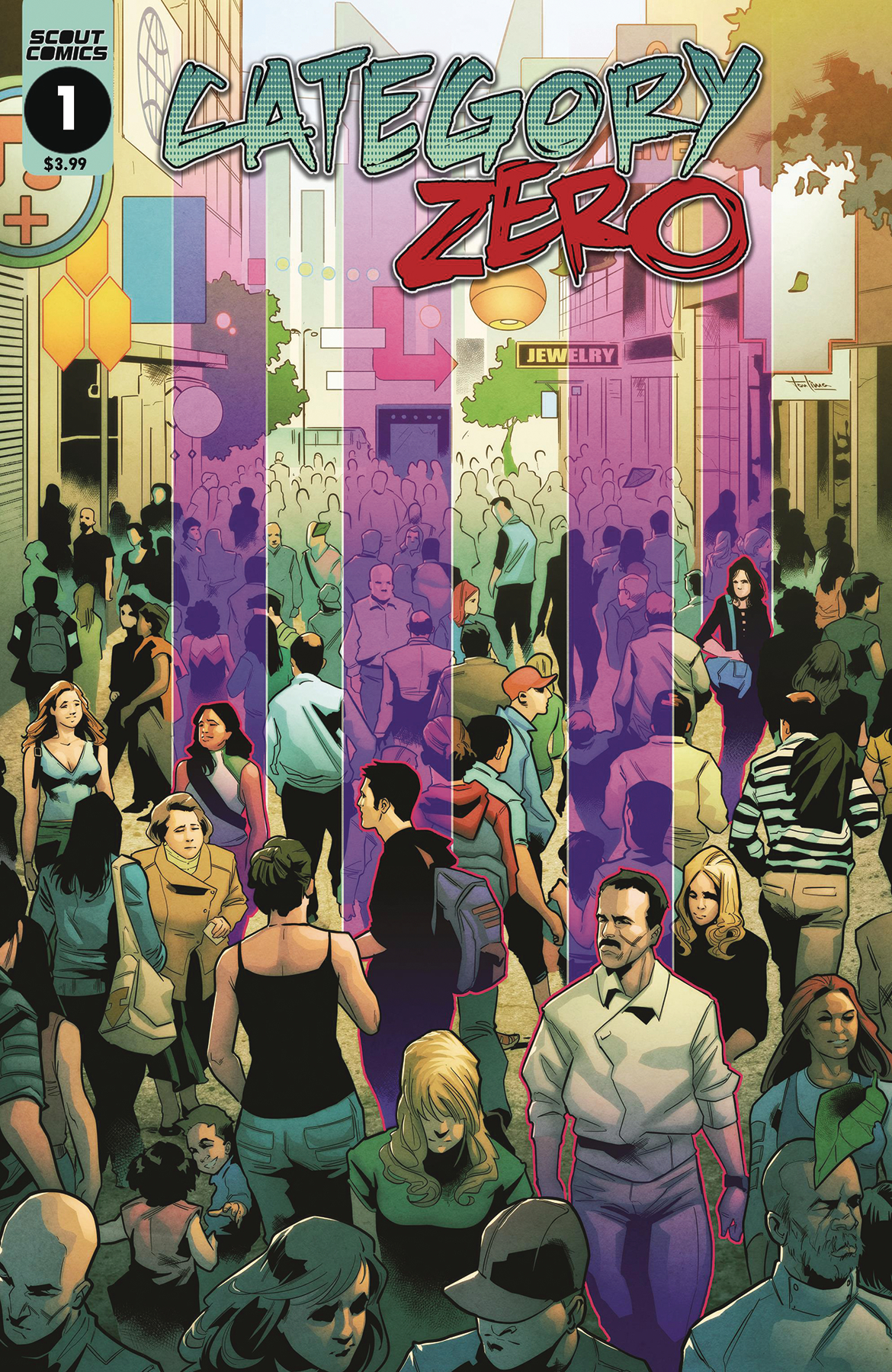
Review of CATEGORY ZERO #1 from Scout Comics

Scout Comics has been on a winning streak lately. With their series THE MALL being optioned for TV, and April’s premier of ELECTRIC BLACK generating buzz among readers and speculators, Scout has established itself as a powerhouse among indie publishers.

This week, Scout debuts a promising new series, CATEGORY ZERO, written by Adam Kiamil, with art by Ton Lima, and colors by Derek Dow. According to Kiamil, the creator, the target audience for this series is those “who grew up reading comics like X-MEN and HARBINGER, but whose tastes have moved away from the traditional superhero genre.”

What’s CATEGORY ZERO about?

Earth’s entire population is infected with the Strix virus. First discovered by scientists at Sanaxus research 20 years ago, the virus and its symptoms manifest in one percent of the population. At the onset of the virus, these “One Percenters” experience flu-like symptoms before abruptly developing superhuman abilities — either physical or mental.

The clever cover of CATEGORY ZERO #1.

In most cases, these powers are harmless, but sometimes, One Percenters pose a threat to the general populace. To treat and study the virus, Sanaxus has developed secure research facilities where known One Percenters live together in suburban-looking communities. As always in the suburbs, things aren’t what they seem.

What’s issue one of CATEGORY ZERO about?

In the opening pages of CATEGORY ZERO, we travel back in time 20 years to meet Phillip Patterson, one of the original Strix researchers at Sanaxus. He has recently been promoted, but suddenly dies at the congratulatory surprise party celebrating his achievement.

Phillip Patterson in his final moments.

With his dying breath, Phillip confesses to his son, Jake (also a Sanaxus researcher), that “Strix isn’t what they say it is.” When Phillip says “they,” I assume he’s referring to Sanaxus, and that whatever they’re lying about will be the engine for the plot in CATEGORY ZERO.

In the present day, Professor Sarah Higgs delivers a lecture on the Strix virus to college students — a seamless way for Kiamil to provide context. One of her students, Neve (who will likely take on a larger role in the series following issue one) asks about her husband and his former professor, Leonard Higgs, a One Percenter receiving treatment at Eden, a Sanaxus facility.

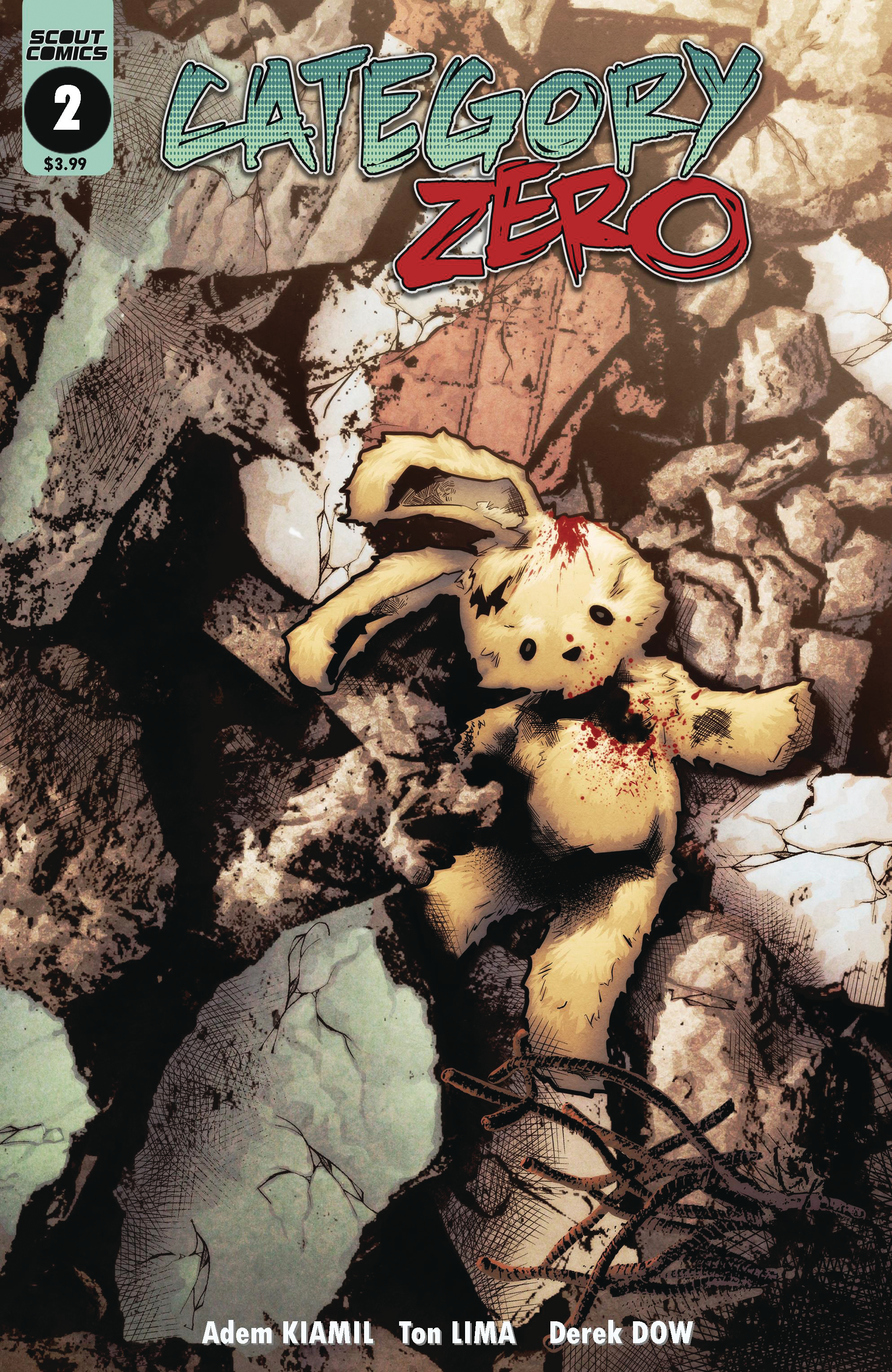
After Sarah and her daughter visit Leonard at Eden, they stop by Arrowbank. While waiting in line, they encounter an ill-looking man coughing uncontrollably. His flu-like symptoms escalate until his hand tremors. Suddenly, the entire building is shaking as if there were an earthquake. Arrowbank collapses, presumably killing everyone inside.

The cover for CATEGORY ZERO #2 is similar to the final panel in issue one.

How’s the reading experience?

In 2019, Americans are, more than ever, considering the experience of marginalized “others” — those who are always disadvantaged, sometimes poor, and generally not part of mainstream society. As such, One Percenters are segregated into isolated communities, further away from the rest of the population who struggle to understand them.

In this way, THE BEAUTY and X-MEN are taken up in CATEGORY ZERO; themes like social exclusion, mutation, viruses, and intervention by governments and corporations are at the forefront. All of this makes the story an ambitious undertaking. Unfortunately, that ambition doesn’t come through in the execution, which feels mostly flat.

The plotting and world-building are the strongest features of this series debut. I liked the multiple timelines in issue one of CATEGORY ZERO, and am curious to see how the past shapes the events I’ll witness as I continue to read .

Released covers for CATEGORY ZERO #3 suggest that Sanaxus has a hidden agenda for the Strix virus and the affected One Percenters.

At the dialogue level, however, the writing was sometimes corny — particularly in the scene where Sarah, Leonard, and their daughter reunite. As a relentless grammarian, I noticed that there were minor blemishes in punctuation and sentence structure; when comics don’t have an editor credited, this is often the case.

Art in CATEGORY ZERO

Generally, the art was impressive and unique. The triangular facial structure of the characters reminds me characters in SUPERIOR SPIDER-MAN by artist Mike Hawthorne. There were impressive backgrounds in larger panels, where the chunky lines gave the art satisfying weight and texture. The color pallet had a muted, sickly green color, which felt entirely appropriate. Overall, though, the art could be more detailed.

Should you invest in the CATEGORY ZERO series?

CATEGORY ZERO is a consistently-paced, somewhat satisfying read sandwiched by two cliffhangers at the beginning and end. I am slightly curious to see where the creators take this series. If the series benefits from more focus, editing, and plotting, I can easily imagine TV and film producers throwing money at the concept.

Rating

6.5 / 10

  • Solid storytelling
  • Timely themes
  • Immersive intrigue
  • Lack of attention to detail

Review of SHE SAID DESTROY #1 from Vault Comics

What’s SHE SAID DESTROY issue one about?

Good versus evil is a classic comics trope. That formula gets a lot more interesting when traditionally evil forces are on the same side as the good guys. Enter the Goddess of death and queen of fairies, The Morrigan.

She is one of the two remaining Gods from her pantheon, who were forgotten and erased. Her only remaining sister, Brigid (Goddess of the Sun) has persuaded the entire solar system into devoutly following her, using the force of inspiration. The Morrigan and her people, who reside in the colony of Fey, are the last obstacle in her quest for domination.

The Sun Goddess, Brigid, about her flagship, The Inspiration.
The Sun Goddess, Brigid, aboard her flagship, The Inspiration.

The only thing stopping Brigid from conquering The Morrigan and converting her followers are Jackelyn (a galactic witch), Winona (the princess of Fey), and her best friend, Raul.

How’s the reading experience?

On the first page, author Joe Corallo implies that because “some gods wanted more,” “cultures were homogenized and erased.” No details of this backstory come through in the issue, but it affirms that Brigid is the antagonist; in her crusade to get every person to conform to her worldview, Brigid has effectively erased the many cultures of the solar system.

Page one of SHE SAID DESTROY introduces the reader to the history of this fantasy universe.

It’s clear the Brigid is motivated by the fate of the other gods: she fears being forgotten as they were. This premise is not entirely unique, and I did not feel an attachment to Brigid and The Morrigan. Their characterization, motivation, and relationship to each other rung hollow.

The apparent protagonist of the series, Winona exudes strong Jon Snow vibes — noble, skilled, and persistent, but somewhat uncomfortable in the spotlight. Much like Brigid and The Morrigan, unfortunately, Winona’s personality is one-dimensional. She is kind to everyone, a good friend, and appreciative of life, but neither Corallo, Kangas (artist), nor Nalty (colorist) indicated that she has endured trauma, or is capable of being anything but good.

Introduction of Winona, and her friend, Raul, who is jealous of her power and prominence in Fey.

This story has the pieces of a successful comics saga: space opera genre, with fantasy and sci-fi elements, conflicting belief systems about to be at war, and an inclusive cast of characters and creators. But did these pieces come together? Not in my opinion.

How’s the art in SHE SAID DESTROY?

Generally, the art in this debut issue parallels the quality of the storytelling: many flat colors, line-work that feels hasty and incomplete, and attempts to convey motion that feel static nonetheless. Often, I couldn’t clearly discern what I was viewing. Even if this visual disruption was intentional, it evoked no emotional response in me.

I will credit Kangas and Nalty with the ability to create imaginative worlds, expressive costumes, and memorable faces with even more distinct facial expressions — this, especially, is rare. All these strengths were apparent in the differences in Brigid and The Morrigan. Exuding a magical aura, the Sun Goddess was regal, enshrined in gold, ephemeral, and evidently at the peak of her power. On the other hand, Brigid, whose powers are waning, had a relaxed posture, more woodsy garb, and several fairies floating around her.

The Saga homage variant of SHE SAID DESTROY issue one.

Should you invest in this series?

After the first reading, I felt profoundly unmoved. After the second round, I felt more appreciation for the narrative structure, characters, and message — but still unmoved.

There is a distinct lack of pacing and world-building that manifests in the hurried art. I most likely will not continue reading SHE SAID DESTROY #1, but respect the intentions of its creators.

Rating 6.5 / 10