
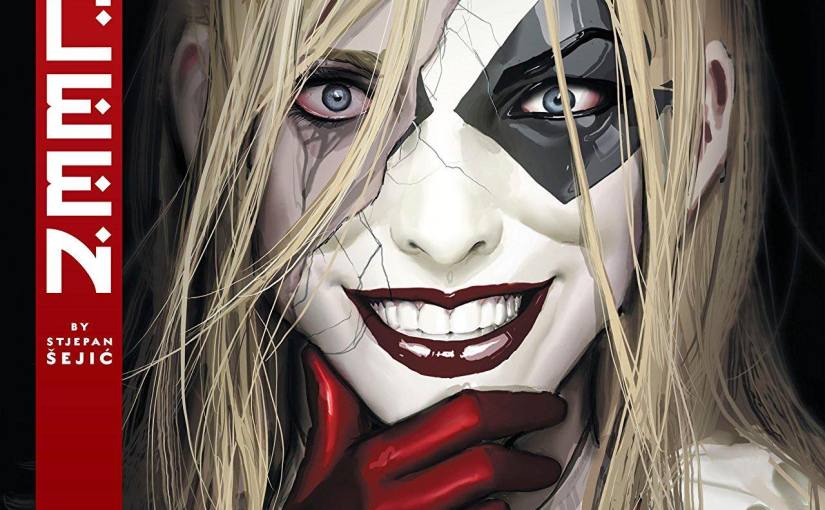
Written by Stjepan Šejić
Illustrated by Stjepan Šejić
Colored by Stjepan Šejić
Lettered by Gabriela Downie

Harley Quinn’s story began when Dr. Harleen Quinzel was walking home from the bar, after the pitch for her criminal psychology research grant didn’t go as well as planned. She’d run into the Joker on Gotham’s streets that night, and her life would never be the same.
“Harleen” Book #1 of 3 is really Act One of Three in terms of the overall story. And so Šejić very clearly sets up the circumstances surrounding the main character’s situation.
Harleen Quinzel is a young psychiatrist whose research got funded against all odds, so she’s on a mission to prove herself and get people to look beyond her past. Dr. Quinzel hypothesizes that Gotham’s most hardened criminals have lost their ability to feel empathy, and that restoring that ability could be both rehabilitative and preventative.
She needs to prove her theory on criminal psychology and validate that she’s where she is now because she’s earned it. And all of this hinges on her ability to study DC’s laundry list of A-list criminals: most notably The Joker, who is locked up in Arkham after Batman took him down the night Harley was walking home.
Locked away, the Joker needs an audience, and she’s listening. (It’s her job, after all.)
Stjepan Šejić (pretty much) single handedly made “Harleen” DC’s best Black Label book thus far. Sixty pages full of constantly entertaining panels later, I’m thinking about how impressive it is that one guy can so fully understand the fundamentals of art and storytelling.
“Harleen” #1 is a story about a bright young woman with a tendency for self-sabotage. Narrated by her future-self, it’s structured to show Harley’s reflections on Harleen’s downfall.
Šejić cleverly repeats verbal motifs for symbolic effect in “Harleen” #1. For example, Harley thinks about her budding relationship with The Joker as stars aligning. It suggests that some mystical element wedged itself between Dr. Quinzel and her science, pulling her towards her fate.
The writer/artist also uses visual motifs to this end in “Harleen” #1. Harley constantly draws on the symbolism of light and shadows, poetically saying how when you’re walking toward the light you can’t see your own shadow behind you. To represent this visually, Šejić creates a half-page panel where Dr. Quinzel walking toward her bright future as a psychiatrist studying Arkam’s most notorious criminals, but behind her the shadow of Harley Quinn lurks with a gun and mallet in hand.

Because “Harleen” #1 is told in retrospect, there is a lot of tension between the past and present in the art. The moment The Joker and Dr. Quinzel first met, both characters flank the leftmost and rightmost side of two splash pages, eyes locked on each other, The Joker pointing his gun directly at her, with panels in between showing all her major decisions up to that life-altering moment. Šejić uses this structure to comment on how life is just a series of decisions leading up to one moment that might undo all those decisions, good or bad.
In these ways, the genre elements of thrillers, tragedies, and romance stories comes through in the art of “Harleen” #1. From the moment Dr. Quinzel meets The Joker, before she learns that her research was even funded, she is doomed.
It seems that Harleen’s hypothesis about criminals lacking empathy might only be half of the story. As she unravels her future by inevitably growing closer to The Joker in Books 2 and 3, she might discover they are the way they are because of self-destructive tendencies. Only then will she be able to empathize with them herself, instead of merely sympathizing as a researcher.
Book 1 of “Harleen” looks at the full spectrum of humanity, from good intentions to hidden agendas. It’s an empathetic portrait of a young woman dealing with doubting colleagues, unexpected success, and people who want her to fail to prove their own point.
Rating: 9.2/10
“Harleen” #1 is surreal, smart, and fun. It’s honest, heartbreaking, human, and most importantly, self-aware.















 Seanan McGuire (A) Takeshi Miyazawa (CA) Jorge Molina


 Secret Society Comics