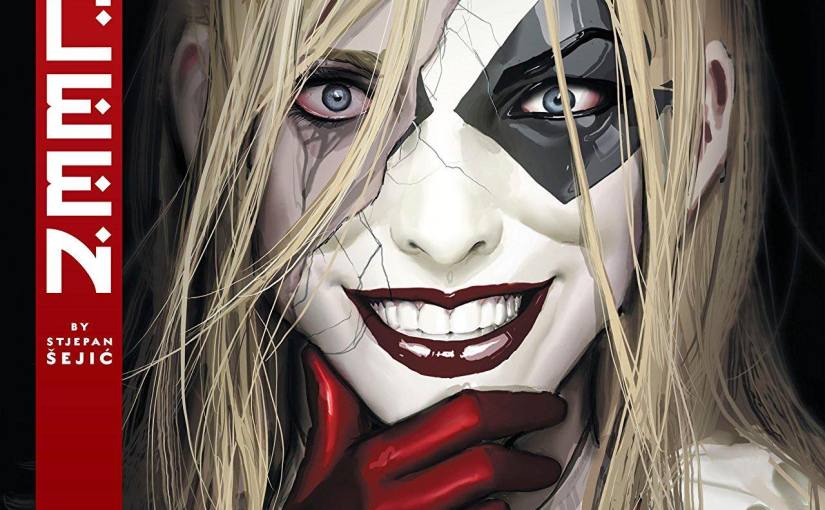
Review: “Harleen” #1 (of 3) from DC’s Black Label

Written by Stjepan Šejić
Illustrated by Stjepan Šejić
Colored by Stjepan Šejić
Lettered by Gabriela Downie

Harley Quinn’s story began when Dr. Harleen Quinzel was walking home from the bar, after the pitch for her criminal psychology research grant didn’t go as well as planned. She’d run into the Joker on Gotham’s streets that night, and her life would never be the same.

Harleen” Book #1 of 3 is really Act One of Three in terms of the overall story. And so Šejić very clearly sets up the circumstances surrounding the main character’s situation. 

Harleen Quinzel is a young psychiatrist whose research got funded against all odds, so she’s on a mission to prove herself and get people to look beyond her past. Dr. Quinzel hypothesizes that Gotham’s most hardened criminals have lost their ability to feel empathy, and that restoring that ability could be both rehabilitative and preventative. 

She needs to prove her theory on criminal psychology and validate that she’s where she is now because she’s earned it. And all of this hinges on her ability to study DC’s laundry list of A-list criminals: most notably The Joker, who is locked up in Arkham after Batman took him down the night Harley was walking home.

Locked away, the Joker needs an audience, and she’s listening. (It’s her job, after all.) 

Stjepan Šejić (pretty much) single handedly made “Harleen” DC’s best Black Label book thus far. Sixty pages full of constantly entertaining panels later, I’m thinking about how impressive it is that one guy can so fully understand the fundamentals of art and storytelling.

Harleen” #1 is a story about a bright young woman with a tendency for self-sabotage. Narrated by her future-self, it’s structured to show Harley’s reflections on Harleen’s downfall. 

Šejić cleverly repeats verbal motifs for symbolic effect in “Harleen” #1. For example, Harley thinks about her budding relationship with The Joker as stars aligning. It suggests that some mystical element wedged itself between Dr. Quinzel and her science, pulling her towards her fate.

The writer/artist also uses visual motifs to this end in “Harleen” #1. Harley constantly draws on the symbolism of light and shadows, poetically saying how when you’re walking toward the light you can’t see your own shadow behind you. To represent this visually, Šejić creates a half-page panel where Dr. Quinzel walking toward her bright future as a psychiatrist studying Arkam’s most notorious criminals, but behind her the shadow of Harley Quinn lurks with a gun and mallet in hand.

Because “Harleen” #1 is told in retrospect, there is a lot of tension between the past and present in the art. The moment The Joker and Dr. Quinzel first met, both characters flank the leftmost and rightmost side of two splash pages, eyes locked on each other, The Joker pointing his gun directly at her, with panels in between showing all her major decisions up to that life-altering moment. Šejić uses this structure to comment on how life is just a series of decisions leading up to one moment that might undo all those decisions, good or bad.

In these ways, the genre elements of thrillers, tragedies, and romance stories comes through in the art of “Harleen” #1. From the moment Dr. Quinzel meets The Joker, before she learns that her research was even funded, she is doomed.

It seems that Harleen’s hypothesis about criminals lacking empathy might only be half of the story. As she unravels her future by inevitably growing closer to The Joker in Books 2 and 3, she might discover they are the way they are because of self-destructive tendencies. Only then will she be able to empathize with them herself, instead of merely sympathizing as a researcher.

Book 1 of “Harleen” looks at the full spectrum of humanity, from good intentions to hidden agendas. It’s an empathetic portrait of a young woman dealing with doubting colleagues, unexpected success, and people who want her to fail to prove their own point.

Rating: 9.2/10

“Harleen” #1 is surreal, smart, and fun. It’s honest, heartbreaking, human, and most importantly, self-aware.
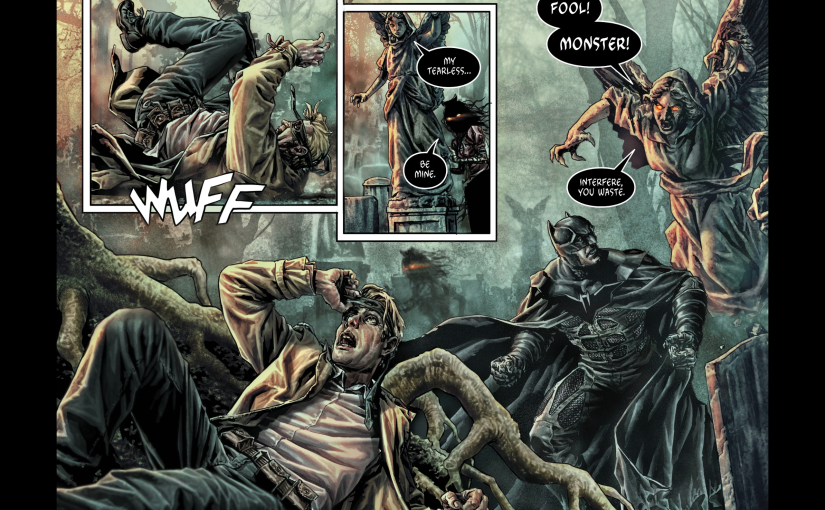
Batman: Damned Review

Brian Azzarello’s and Lee Bermejo’s disorienting run together on Batman: Damned can be interpreted in many different ways, and I think that’s partly the point. I won’t be the authority on this story. I think the closest person to come to that — other than Azzarello himself — is Rich Johnston in his recent review, which connects the Damned to Alan Moore’s Killing Joke and Azzarello’s Joker from nearly a decade ago. Instead, I’ll share my interpretation, which is one I didn’t find elsewhere in the other reviews I read.

I’ll skip over the controversy of Bat Wang, the complaints about Azzarello’s relentless punning, the bitching about how flat the blood looks, and get right to the point of my review. I think that superhero comics, at their best, are always a mythology story. Batman: Damned is a mythological story about a man confronting fear, lack of control, judgment, childhood trauma, and desire. It features infidelity, weeping, attempted rape (a more sensible version than the attempted rape in Miller’s Superman: Year One), empathy, confusion, and all the other emotions that make being human so damn exhausting.

I reread the all three books of Batman: Damned in one day, and still struggled to be confident in my interpretation — until the start of my fourth go-around when I realized that the narrator implies that the hero is in hell, and that his quest is more about finding himself than finding out if the Joker is truly dead: “Literally bloody hell. I say that, havin’ a knowledge of it. An’ the depths we’ll go to ESCAPE it.” (If you’re curious about the heavy-handed Britishness of the quote, it’s because narrator is Constantine, who’s more a vehicle for Azzarello’s voice and style than anything else. That’s all I have to say about that.)

Once I accepted that Batman is in hell, and that the myriad of supernatural DC characters were there just to add to the story, the entire plot that follows from that moment in issue one onward became much more straightforward. The laws of storytelling become more flexible, leaving Azzarello and Bermejo plenty of room to craft creative transitions and moments of poetry.

The “Batman is actually dead this whole time” interpretation explains all the abrupt transitions in setting from hotel to cathedral to underground rap concert to graveyard to magic club. It means that the moment Batman falls from the bridge (which is what we’re misled to think actually happened) is really his descent into hell and the beginning of his judgment. It means Batman died on top of trash bags in the street after the Joker stabbed him, and he’s touring hell awaiting the judgment that finally comes in issue 3. Once he’s in the G.C.P.D. morgue, Batman fittingly decides his own fate, finally surrendering himself to death.

This storytelling technique isn’t what makes the books of Damned mythology or even part of the comics canon. It’s Batman’s true foe in the story: not the Joker, but Desire and Fear of Desire, the character otherwise known as Enchantress. She is a demon who strikes a deal with young Bruce: “no tears for fears.” This serves as Batman’s origin story. She torments him his whole life — from childhood to manhood — like death trying to claim him, to get him to surrender. Her presence is associated with Thomas Wayne’s infidelity to his wife Martha, and Bruce’s discovery of how this torments his mother. Even when Batman “defeats” Enchantress, she ultimately wins in the end. No matter how strong the hero, no matter how much money he has, no matter how long his wang is, he will always have to surrender to death.

Speaking of heroes, Lee Bermejo’s art is a herculean achievement. I place him in the elite rank of Alex Ross, and would even dare to say that I prefer Bermejo’s renditions of the human form, cityscapes, facial expressions, action sequences, and landscapes to those of Ross. I was especially impressed by the way he conveyed the aftershock when Harley Quinn’s bombs went off in Gotham, and how he illustrated the confusion Batman experienced while drugged. He made this story horrific.

It’s a real shame that people didn’t have more patience for Damned, and it’s an even bigger shame that the executives at DC cowered from the clear momentum that this book had.

Superman: Year One is the Comic that Nobody Needed, Especially in 2019

If you’re going to judge a book by its cover, then comic books are perfect for that. The covers for Superman: Year One #1 are pretty uninspiring. So is the book itself. But it’s more than uninspiring. It’s cruel.

Frank Miller and John Romita Jr. team up for a modern-day retelling of Superman’s origins — except there’s nothing modern about it. Let’s get the stale plot out of the way so that we can talk about the stagnant idea behind it, the cancerous stereotypes, and the dusty tropes.

Krypton blows up. In a rocket made by his father, Kal catapults through the galaxy. He crashes into earth, where he meets his parochial parents and becomes Clark Kent. Immersed in Miller’s version of Americana, Clark grows up, fights off some bullies, saves his crush from a gang-rape (more on this disastrous scene in a bit), plays some football, gets laid, and then enlists in the Navy.

Father-son “wisdom” at the expense of women everywhere. Classic!

As you can see, the plot isn’t innovative or remarkable. But it does make you see Superman in a new light. That light isn’t flattering.

Clark doesn’t have any interiority here. If he does, all we get is his sense of superiority and frustration. Sure, Clark’s a teenager, but his thoughts reek of Miller’s own prejudices and teenage hangups — from sexist comments, creepy innuendos, obnoxious bravado, to stubbornness that’s nothing more than stupid.

Before the bullies escalate their crimes against innocent podunk Kansas to rape, they’re doing the classic bully stuff that has been portrayed in American film and TV for decades. Amid this yawn-inducing buildup, Clark says, “This is madness. Madness. Why?” It’s because they’re bullies, Clark. This is as deep as Clark Kent gets in Miller’s hellscape.

The bullies achieve obligatory villain status when they attempt to gang-rape Clark’s crush, Lana. She’s on the dirt, crying, with some hands holding her down, others touching her where she’s vulnerable. Clark saves her before the violence escalates, commenting on how feeble human beings are all the while. He then whisks Lana up into the clouds before dropping her at home and asking “Let me court you, Lana Lang” with no regard for what she just endured, no curiosity, no compassion, no sorrow, no anger. It’s incel savior mentality at its worst.

Clearly, the intent and ideas behind Miller’s writing are lacking. So is his style. The voice of the narrator drunkenly wobbles between Miller and Clark Kent. There’s a matronly-looking teacher who says “dumplings,” “my blossoms,” and “angels” within four fucking panels. There’s establishing narrative captions, like “Back home. Supper time” that are entirely pointless because we can see that Clark is indeed at home eating food.

The worst and most prominent lack of style is the unnecessarily bolded font. In the very next panel after the rape scene, here’s what Frank Miller has to offer the people who paid eight dollars to read this: “Boning up there, Mr. Kent?” (Lana) “Damn if Lana doesn’t just have a way of saying things…” (Clark). Excuse me while I go hibernate in a nuclear winter.

An unoriginal sex pun. Nice!

Comics are collaborative, so Miller can’t fully bear the weight of this book’s crushing failure — with the exception of letterer John Workman and colorist Alex Sinclair. Workman excels at making Miller’s gratuitous dialogue highly legible, neat, and crisp. Alex Sinclair imbues finer textures, like prairie grass and hair, with colors that feel natural and bright. John Romita Jr. may have sprung from the loins of a legend, but apparently it takes more than that to draw children’s heads proportionally. Many times, Clark Kent looked like a bobblehead. Danny Miki’s crosshatching is too clumsy and spaced out, while his line weight is unbearably light and heavy. Then again, no inker could salvage Romita Jr.’s creepy take on the human form.

The first installment of this new Superman series was the perfect opportunity for Miller to explore Clark Kent’s boyish charm in a complex, characteristically dark way for the author. Instead, we all can see how immature Frank Miller really is. There’s nothing charming about it. While this Black Label retelling of Superman’s origin is supposed to deviate from the world’s first superhero who we know and love, it’s nothing more than a perversion.

Rating 3/10